5 Best Drip Irrigation Emitters and When to Use Each Type
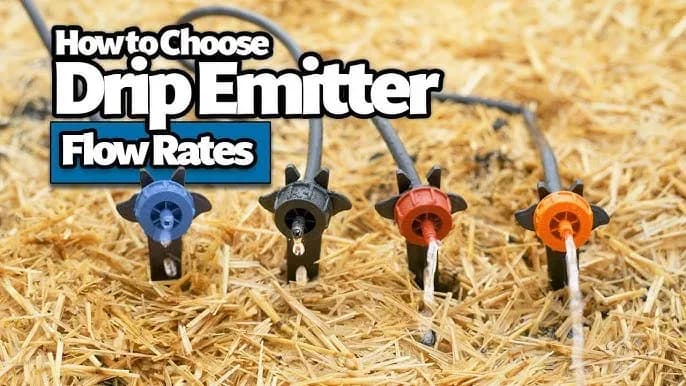
Summary: The best drip irrigation emitter is the one that matches the field, not simply the most expensive one. The five main types are pressure-compensating emitters, non-pressure-compensating emitters, button emitters, inline emitters, and adjustable emitters. Pressure-compensating models use a diaphragm to hold a steady flow across pressure changes, often in a range of about 0.5 to 4.0 bar according to common manufacturer specifications. Non-PC emitters cost less and work well on flat, short runs. Button emitters offer layout flexibility. Inline emitters suit permanent crops. Adjustable emitters provide per-plant control. Choosing correctly protects distribution uniformity, reduces clogging problems, and keeps water delivery aligned with crop demand.
What a drip emitter does
A drip emitter, or dripper, meters water from a pressurized line into the soil at a controlled rate. It controls how much water each plant receives, how well pressure changes are handled, and how easily the system clogs.
For available models, see the IrriNex drippers range.
1. Pressure-compensating emitters
Pressure-compensating emitters, often called PC emitters, use a flexible diaphragm to stabilize discharge. They are the safest choice for slopes, long runs, and high-value crops.
Step 1: Use PC emitters when pressure changes across the field
If elevation changes more than 1 m over 50 m of line, PC emitters usually pay for themselves. They reduce the difference between upper and lower plants.
2. Non-pressure-compensating emitters
Non-PC emitters use a fixed labyrinth channel to slow water. They have no moving diaphragm, which keeps cost low and reliability high on flat fields.
Step 2: Use non-PC emitters on flat, short runs
They suit annual vegetables, small orchards, and budget-sensitive projects with stable pressure. Keep line length and flow inside the tubing limit.
3. Button emitters
Button emitters are inserted into plain tubing wherever water is needed. They are useful when plant spacing changes or crops are mixed.
Step 3: Use button emitters where layout flexibility matters
They work well in greenhouses, nurseries, and research plots. The tradeoff is installation labour because each emitter is punched by hand.
4. Inline emitters
Inline emitters are built into the tubing during manufacturing. They cannot be pulled out and are protected inside the line wall.
Step 4: Use inline emitters for permanent plantings
They suit orchards, vineyards, berries, and long-term vegetable beds. See IrriNex inline drip pipe and drip tape.
5. Adjustable emitters
Adjustable emitters let workers tune each point manually. They cost more and need more supervision, but they solve mixed water-demand problems.
Step 5: Use adjustable emitters only when individual control is needed
They are useful in container nurseries, research trials, and gardens with very mixed plants. For single-crop fields, fixed emitters are usually simpler.
Emitter comparison table
| Emitter type | Main strength | Main limit | Suitable for |
|---|---|---|---|
| Pressure-compensating | Stable flow on slopes and long runs | Higher cost | Suitable for orchards, vineyards, hillside fields |
| Non-PC | Low cost and simple design | Flow changes with pressure | Suitable for flat vegetable fields and short runs |
| Button | Custom spacing | More installation labour | Suitable for greenhouses, nurseries, research plots |
| Inline | Durability and factory spacing | Less flexible after installation | Suitable for permanent crops and commercial farms |
| Adjustable | Manual flow control | Higher cost and more maintenance | Suitable for container production and mixed plantings |
How to choose the right emitter
- Measure slope. Slopes and long lines point toward pressure compensation.
- Check crop permanence. Long-term crops justify inline systems; annual crops may not.
- Measure source pressure and flow. Emitters cannot fix a poorly sized zone.
- Assess water quality. Dirty water needs better filtration before it reaches any emitter. Use the IrriNex filter selection guide.
- Compare lifetime cost. A cheap emitter can become expensive if it creates uneven growth or frequent maintenance.
Bottom line
Pressure-compensating emitters are best for slopes and long lines. Non-PC emitters are best for flat, low-cost layouts. Button emitters give flexibility, inline emitters give durability, and adjustable emitters give control. Match the emitter to field conditions first, then compare price. For complete layouts, review the IrriNex greenhouse drip solution and vegetable drip irrigation solution.