Water Quality Classification: Settleable, Suspended, and Biological Loads
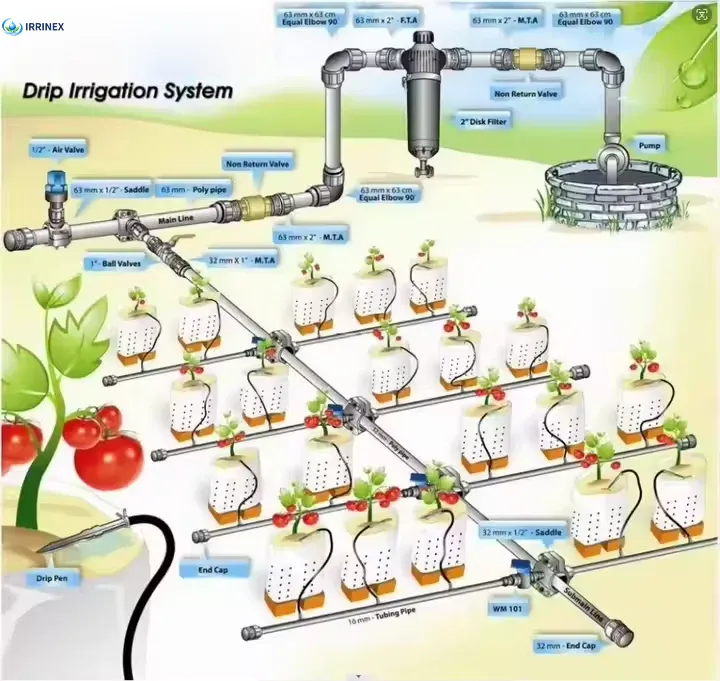
In micro-irrigation engineering, filtration is not merely an accessory; it is the primary life-support system of the network. Modern drip emitters feature turbulent labyrinth flow paths with passage dimensions ranging from 0.5 to 1.2 mm (500 to 1,200 microns). Particulates larger than one-tenth of the emitter orifice width will bridge across labyrinth teeth, accumulate organic slime, and cause irreversible emitter clogging. Proper equipment selection begins with identifying the primary physical and biological contaminants in the source water:
- Inorganic Mineral Solids (Sand and Silt): High specific gravity (> 2.6). Settleable coarse sand (> 75 μm) is characteristic of deep agricultural wells, while fine abrasive silt (10 to 50 μm) dominates river diversions. These particles cause rapid mechanical abrasion on plastic valve seats and emitter orifices.
- Biological & Organic Loads (Live Algae, Zooplankton, Debris): Neutral specific gravity (1.0 to 1.1). Open storage reservoirs, farm dams, and irrigation canals foster filamentous green algae, diatom blooms, and organic flocs. Biological contaminants are compressible, flexible, and capable of squeezing through rigid screen mesh under hydraulic pressure.
- Dissolved Chemical Precipitants (Iron, Manganese, Calcium Carbonate): Soluble ions that oxidize into insoluble gelatinous ferric hydroxide sludge or hard mineral scale upon exposure to atmospheric oxygen or pH shifts.
Filtration Technology Matrix: Screen, Disc, Media, and Hydrocyclone
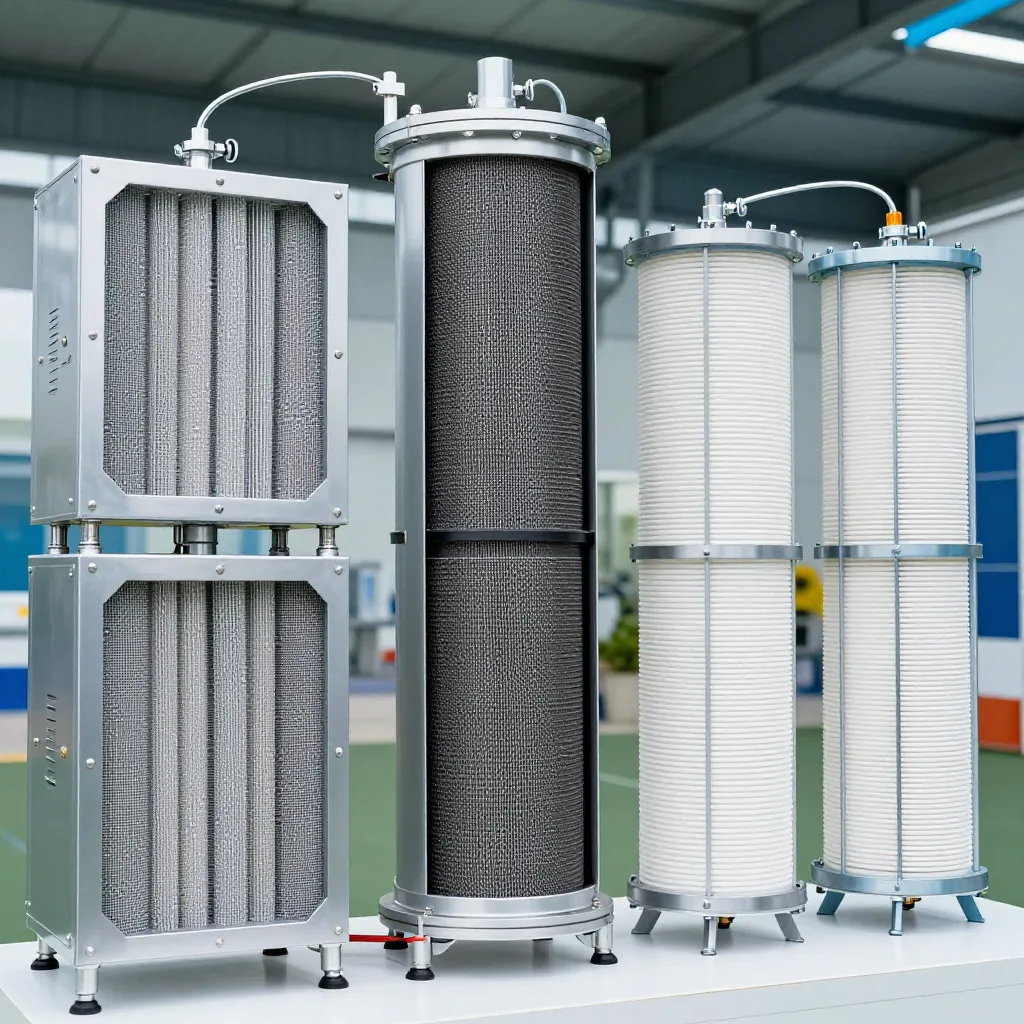
Each filtration technology employs fundamentally different physical separation mechanics. The table below provides an engineering comparison across primary operating parameters:
| Filtration Technology |
Separation Mechanism |
Primary Particle Target |
Standard Micron Rating |
Clean Pressure Drop |
Backwash Trigger (\(\Delta P\)) |
Recommended IrriNex SKU |
| Screen Filter |
2D Surface barrier mesh |
Rigid mineral sand, pipe scale, rust flakes |
100–180 μm (80–150 mesh) |
0.10–0.15 bar (1.5–2.2 psi) |
0.50 bar (7.25 psi) |
FLT-SCR-S / FLT-SCR-STL |
| Grooved Disc Filter |
3D Depth stacked grooved rings |
Organic biological slime, filamentous algae, silt |
100–130 μm (120–150 mesh) |
0.15–0.25 bar (2.2–3.6 psi) |
0.50–0.60 bar (7.25–8.7 psi) |
FLT-DSC-Y / FLT-DSC-T |
| Sand Media Filter |
3D Volumetric crushed silica bed |
Heavy organic blooms, reservoir algae, colloidal clays |
50–100 μm (equivalent) |
0.20–0.30 bar (2.9–4.3 psi) |
0.50 bar (7.25 psi) |
FLT-SAND (Dual Tank) |
| Hydrocyclone Separator |
Centrifugal vortex separation |
Coarse mineral sand (> 75 μm, SG > 2.6) |
75 μm and larger |
0.30–0.50 bar (4.3–7.2 psi) |
Periodic underflow chamber purge |
FLT-CYC |
Hydraulic Sizing and Face Velocity Design Criteria
Sizing an irrigation filter bank strictly by pipe connection diameter (e.g., buying a 3-inch filter because the mainline is 3-inch) is a critical engineering mistake. Filters must be sized on effective filtration surface area (\(A_{\text{eff}}\)) and allowable face velocity (\(v_f\)):
$$v_f = \frac{Q_{\text{station}}}{A_{\text{effective}}}$$
When filtering dirty surface water laden with organic matter, the allowable velocity must be derated by 30% to 50% compared to clean well water. Exceeding permissible velocity limits forces deformable algae filaments through the filter media, while creating severe pressure drop that accelerates mechanical wear on backwash valves.
Mesh vs Micron Conversion Standard (ISO 9261 Compliance):
- 80 Mesh (180 microns): Recommended for landscape turf rotors and overhead impact sprinklers.
- 120 Mesh (130 microns): The universal global micro-irrigation standard for drip tape (IrriNex DRT-FLT) and pressure-compensating button emitters (IrriNex EMT-PC).
- 150 Mesh (100 microns): Required for fine turbulent labyrinth driplines operating in heavy silt soils.
- 200 Mesh (75 microns): Mandatory for greenhouse micro-foggers and inverted hanging misting nozzles.
Master Agricultural Filtration Decision Tree
Follow this systematic decision pathway to establish the primary filtration battery:
- Is the primary water source an agricultural borehole or deep groundwater well?
- Yes, and sand content > 50 mg/L: Install a hydrocyclone sand separator (`FLT-CYC`) as a pre-filter, followed by a secondary 120-mesh disc filter (`FLT-DSC-Y`).
- Yes, and water is clean (sand < 10 mg/L): Install an automatic or manual disc filter battery sized for 120% of station flow.
- Is the water drawn from an open surface reservoir, farm canal, or wastewater retention basin?
- Yes, with heavy seasonal algae blooms: Deploy a dual-tank crushed silica sand media filter station (`FLT-SAND`) equipped with automatic differential pressure backwash controls. Provide downstream 120-mesh disc check filters.
- Yes, with moderate turbidity and canal silt: Deploy a multi-spine automatic self-cleaning disc filter array with tangential spin-backwash.
- What is the maximum station operating flow rate?
- Always apply a safety headroom factor: design the filtration battery for 125% to 135% of peak block demand to ensure delivery during backwash cycles.
Hydraulic Backwash Mechanics and Water Consumption
During backwash, clean filtered water is reversed through the dirty element to displace trapped solids out through an auxiliary waste drain. In automatic disc filter systems, an internal hydraulic piston decompresses the grooved disc stack while tangential spray nozzles blast high-velocity water jets (v > 18 m/s), spinning the discs free within 15 to 30 seconds. In media tanks, water velocity must achieve 50 to 65 m/h to fluidize the silica sand bed by 25% to 35% expansion without washing sand out of the top discharge manifold.
Deep Silica Sand Media Bed Fluidization and Media Grade Sizing
In high-turbidity surface water operations, sand media filters (IrriNex FLT-SAND) represent the gold standard for trapping organic loads. The physical separation occurs throughout the three-dimensional depth of sharp crushed silica sand, rather than across a two-dimensional surface plane. Engineering success relies on specifying the correct media grain size and bed depth:
- Crushed Silica Sand #16 (0.65 mm to 0.85 mm effective size): Standard for agricultural surface water. Sharp-edged angular quartz grains interlock to trap filamentous algae down to 50–75 microns. Rounded river sand must never be used because smooth rounded grains pack too tightly and lack sharp retention angles.
- Crushed Silica Sand #20 (0.45 mm to 0.55 mm effective size): Utilized for high-value greenhouse fertigation and micro-spray lines where filtration down to 40–50 microns is mandatory. Requires higher backwash pressure and flow rates.
- Bed Depth and Freeboard: Commercial media tanks require a minimum sand bed depth of 400 mm to 500 mm (16 to 20 inches). A critical design dimension is the freeboard—the open vertical headspace between the settled sand bed and the top inlet diffuser. Freeboard must equal at least 40% to 50% of the settled bed depth to accommodate 25% to 35% bed expansion during hydraulic fluidization without discharging silica sand into the drain manifold.
Differential Pressure Automation & Solenoid Backwash Control Loops
Operating a filtration battery manually relying on periodic visual inspection inevitably leads to either premature backwashing (wasting water and pumping energy) or severe filter clogging that starves downstream crops. Commercial irrigation stations must integrate an automated differential pressure (\(\Delta P\)) control loop:
$$ \Delta P = P_{\text{inlet}} - P_{\text{outlet}} $$
The control architecture incorporates high-precision hydraulic sensing and automated sequencing:
- Differential Pressure Sensor Calibration: A dual-port differential pressure transducer continuously monitors the head loss across the filter bank. The electronic controller triggers a backwash cycle when \(\Delta P\) reaches **0.50 to 0.60 bar (7.25 to 8.7 psi)** above the clean baseline.
- Time-Based Overrides: Even if the differential pressure threshold has not been reached, the controller enforces a maximum elapsed time interval (typically 4 to 8 operating hours). This prevents biological algae from forming an anaerobic crust and cementing the filter media during low-flow cycles.
- Sequential Backwashing: In a multi-station disc or multi-tank media array, the controller washes one pod at a time using clean, filtered water produced by the remaining operating pods. A hydraulic backwash valve (IrriNex IRX-OOCV) isolates the pod from the main delivery line and diverts backwash discharge to the drainage sump.
- Dwell Time and Stabilization: A programmable dwell time of 5 to 10 seconds is maintained between consecutive pod washes to prevent system pressure drops and eliminate hydraulic hammer in downstream lateral piping.
Chemical Disinfection and Acid Descaling Protocols
Physical filtration alone cannot permanently eliminate bacterial biofilms, iron slime, or mineral scale that precipitate downstream of the filter station. Routine chemical sanitation maintains clean filter beds and prevents emitter clogging:
- Shock Chlorination for Algal and Bacterial Slime: When disc or media filters exhibit rapid clogging cycles despite frequent backwashing, biological slime is fouling the media surfaces. Introduce sodium hypochlorite (industrial bleach) upstream of the filter station using an IrriNex FRT-VEN Venturi injector to achieve a free residual chlorine concentration of 20 to 50 ppm at the lateral flush ends. Shut the system down and allow the chlorinated water to soak in the filters and pipes for 4 to 12 hours before flushing thoroughly to waste.
- Acid Descaling for Carbonate Scale: In hard alkaline well waters (pH > 7.8, bicarbonates > 250 mg/L), calcium and magnesium carbonates precipitate on disc grooves and screen mesh, locking fine silt into an impervious concrete-like crust. Inject technical-grade hydrochloric or phosphoric acid to lower the water pH in the filter manifold to 4.0 for 30 to 60 minutes. The acidic solution dissolves carbonate binders, allowing accumulated mineral scale to be blasted away during subsequent backwashing.
Filtration Station Layout and Piping Integration
Proper hydraulic piping at the filter headworks protects both the filtration elements and downstream equipment. The engineering installation layout must adhere to five structural rules:
- Inlet and Outlet Isolation Valves: Install resilient-seated IrriNex VAL-BV-LG isolation valves immediately before and after the filter bank to enable offline element servicing and manifold maintenance without draining the primary farm mainline.
- Upstream Pressure Relief: Deep-well turbine and centrifugal pumps can produce severe start-up surges. Position an IrriNex IRX-SPR pressure relief valve upstream of the filters set 1.0 bar above maximum operating pressure to vent hydraulic shock waves before they deform disc spines or screen cylinders.
- Continuous Air/Vacuum Relief: Position a double-acting combination air valve at the highest point of the inlet and outlet manifolds. During filter startup, large volumes of air must escape rapidly without slamming the filter lids; during shutdown or drainage, air must enter immediately to prevent vacuum collapse of plastic filter housings.
- Downstream Check Protection: Install a stainless spring-assisted check valve (IrriNex CHKN1-ZDB) downstream of the filter station to eliminate backflow from elevated field blocks during emergency shutdowns.
Frequently Asked Questions on How To Select An Irrigation Filtration System
What is the standard filtration grade required for agricultural drip irrigation emitters?
Industry standard (ISO 9261) requires 120 mesh (130 microns) filtration for standard drip tape and driplines. High-flow sprayers can use 80 mesh (200 microns), while micro-foggers require 150 to 200 mesh (75–100 microns).
Why are screen filters ineffective for surface water containing live filamentous algae?
Screen filters provide only 2D surface filtration. Long, flexible organic algae filaments align with the water flow and squeeze through the mesh holes under pressure, or form an impermeable slime cake that blinds the screen immediately. Disc or sand media depth filtration is mandatory.
When should a hydrocyclone sand separator be installed as a pre-filter?
When well or river water contains heavy settleable mineral sand (particles $> 75\,\mu\text{m}$ with specific gravity $> 2.6$). Hydrocyclones remove over 98% of heavy sand centrifugally with zero moving parts, protecting downstream disc filters from abrasion.
How do you size an irrigation filter bank relative to maximum zone flow rate?
Size the filter bank for at least 120% to 130% of maximum system design flow rate. In dirty surface water, apply a 30% to 50% derating factor to ensure adequate clean water flow even as elements load up before backwashing.