
Technical2026-10-22
Use a second irrigation measurement when one bad signal can cause unacceptable crop, water, energy, safety, or equipment consequences and an independent check can detect that failure before the control system acts. Do not duplicate every sensor. Rank the failure first, identify how the original channel can fail, then choose either a genuinely independent same-variable measurement or a different physical signal such as flow, pressure, IrriNex IRX-OOCV hydraulic control valve position, soil response, weather, or plant response.
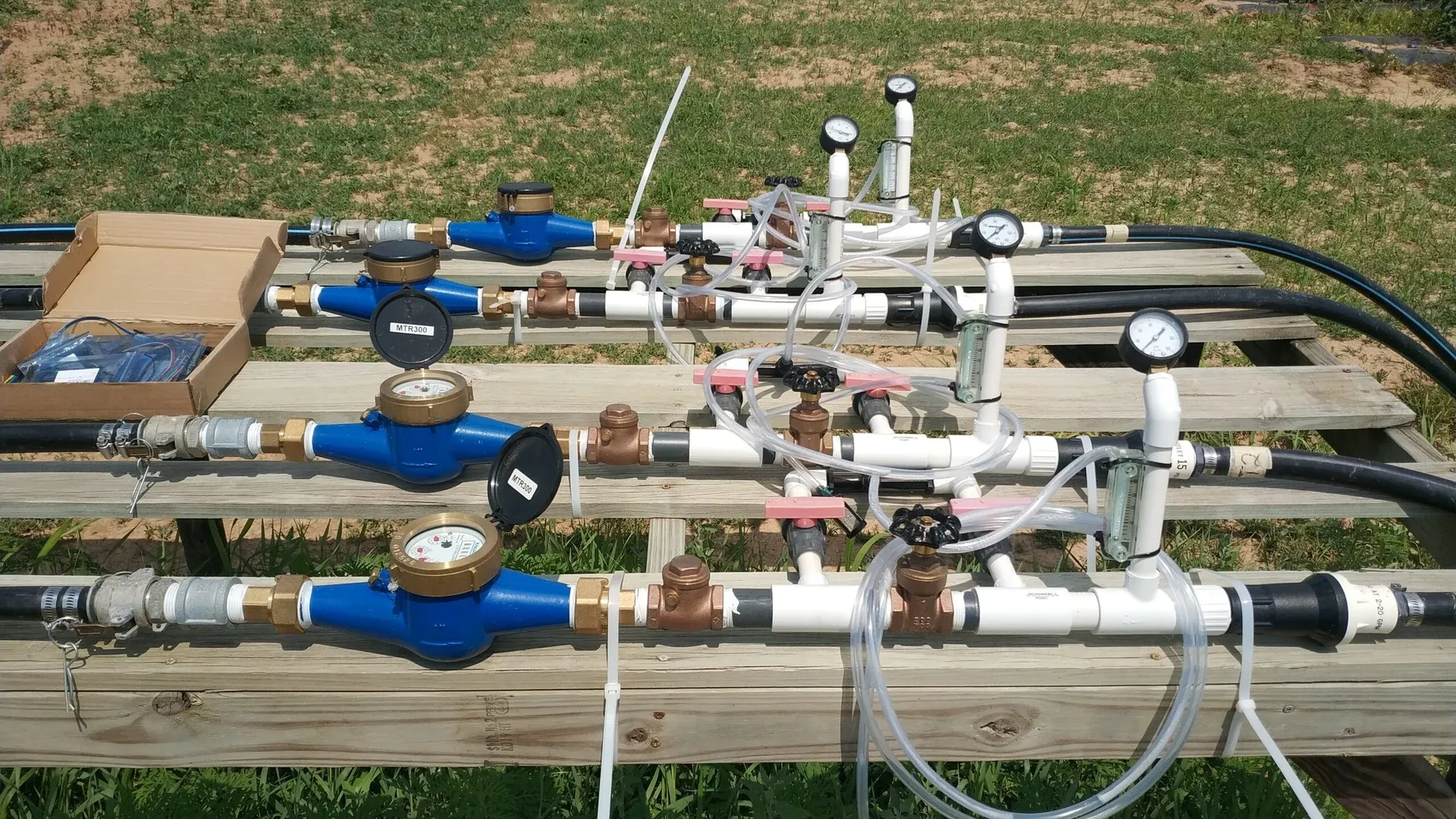
A real field test rig uses parallel water meters, pressure gauges, valves, pipes, and clear measurement tubes in an agricultural plot. The repeated instruments make measurement comparison visible, although the photograph does not validate any design or threshold in this guide. Photo source: Northeast SARE project report LNE19-378; cropped, resized, and converted to WebP without generative editing.
This guide treats irrigation sensor redundancy as a reliability decision within precision irrigation. It provides a failure-ranking method, cross-check matrix, worked example, control rules, commissioning tests, and a maintenance record. It does not replace the installed instrument manuals, electrical and hydraulic safety procedures, local agronomy, or a formal safety assessment for a specific farm.
Redundancy is useful only when it changes a decision. Two sensors that display similar numbers but feed no alarm, fallback, or maintenance action add cost without controlling risk. For each measurement, write the decision it supports: start a zone, stop a pump, maintain pressure, detect a leak, calculate applied depth, dose fertilizer, or warn an operator. Then state what the system must do when confidence in that measurement falls.
There are three distinct patterns. Duplicate measurement uses two instruments for the same variable, such as two pressure transmitters at one hydraulic point. Diverse measurement observes the same process through another physical variable, such as valve feedback plus measured flow. Analytical redundancy compares a reading with a model or water balance, such as expected zone flow derived from verified IrriNex EMT-PC dripper count and operating pressure. These patterns solve different failures and should not be treated as interchangeable.
A second device is not automatically independent. Two transmitters may share one pressure tap, power supply, cable trench, radio gateway, configuration file, clock, or calibration error. A blocked impulse line or incorrect unit can therefore make both channels agree while both are wrong. The design must name common dependencies before it claims redundancy.
Start with the consequence of a false high, false low, frozen value, missing value, and delayed value. A false-high pressure reading may cause a controller to increase pump speed. A false-low soil-moisture value may prolong irrigation. A frozen flow value can hide a broken lateral. A delayed weather observation may be harmless for a daily report yet unsafe if it directly commands frost protection or irrigation shutdown.
Use four practical consequence levels. A minor failure affects reporting and can wait for routine inspection. A manageable failure creates water or labor loss but the operator has time to verify it. A serious failure can damage a crop block, pump, IrriNex FLT-DSC-Y disc filter, mainline, or dosing process before the next visit. A critical failure can cause an unacceptable safety, contamination, flooding, or equipment event. Define the words for the farm; do not copy a generic label without limits.
| Measurement use | Plausible bad-signal result | Time to harm | Initial protection choice |
|---|---|---|---|
| Dashboard trend only | Misleading report or delayed maintenance | Days to weeks | Quality flag, periodic manual check |
| Operator alarm | Nuisance call or missed developing fault | Hours to days | Persistence rule and independent confirmation |
| Automatic zone start/stop | Overwatering, water stress, runoff, or deep drainage | Minutes to hours | Validated fallback and cross-check before actuation |
| Pump speed or pressure control | Overpressure, unstable control, cavitation exposure, poor distribution | Seconds to minutes | Hard limits, separate trip where warranted, safe manual mode |
| Fertigation permissive | Injection without adequate water flow or wrong concentration | Minutes | Independent flow permissive, EC/pH checks, controlled shutdown |
The result is a ranked list, not a universal rule that every automatic function needs two identical sensors. When a conservative hardwired limit, mechanical relief device, local gauge, timed maximum runtime, or operator check already limits the consequence, that protection may be more effective than another networked transmitter.
List range exceedance, drift, offset, hysteresis, freeze damage, water hammer, fouling, debris, poor soil contact, salinity influence, temperature influence, blocked pressure ports, air pockets, reversed installation, damaged cables, animal damage, condensation, low battery, and physical impact. The relevant list depends on the technology and field. The purpose is to choose a second channel that does not fail for the same reason.
A healthy sensing element can still deliver a bad control input. Include lost power, weak solar charging, gateway outage, radio shadow, repeated last-known value, stale timestamp, packet reordering, wrong device address, swapped channels, lost unit metadata, scaling error, and dashboard aggregation. Data age must travel with the value; a plausible number from yesterday is not a current measurement.
A technically correct sensor may not represent the managed area. One soil probe can sit in a wet emitter bulb while most roots are dry. A mainline flow meter can be healthy while the wrong valves are open. A weather station can be shaded or located outside the field's wind exposure. These are sampling failures. Installing a duplicate at the same biased point repeats the problem instead of controlling it.
The University of Arizona Cooperative Extension documents soil variability, harsh weather, battery and connectivity problems, cable damage, placement effects, drift, and the need for field checks and calibration. Its guide to maintaining and calibrating field-installed moisture sensors supports the maintenance and validation approach used here.
Use two same-type instruments when the variable itself must be known directly, the consequence justifies the cost, and the channels can be made sufficiently independent. Examples include two pressure transmitters with separate ports where loss of pressure protection is serious, or two representative soil stations when spatial variability is a known risk. Compare both with a traceable field reference during commissioning.
Prefer diverse measurement when a second copy would share the main failure mode. Flow plus pressure separates many hydraulic faults better than two pressure readings. A valve command plus valve-position feedback still does not prove water delivery; add measured flow where that consequence matters. The irrigation valve maintenance checklist helps connect mechanical inspection with the command, position, and delivered-flow evidence.
Use analytical redundancy as a reasonableness check, not as invented precision. Expected flow can be calculated from a verified zone configuration and then compared with a meter. A daily soil-water balance can challenge a soil-moisture trend. These estimates inherit uncertainty from emitter discharge, pressure, crop coefficients, weather, soil storage, and configuration. Record those limits before a model is allowed to overrule a physical reading.
| Primary signal | Independent check | What disagreement can reveal | Important shared dependency |
|---|---|---|---|
| Main or zone flow | Pressure before and after the controlled boundary | Leaks, restrictions, open flush points, weak source, or meter error | Both may depend on the same gateway and clock |
| Pressure transmitter | Local mechanical gauge or second port | Drift, blocked port, surge damage, scaling, or wiring failure | One tapping point may be blocked for both |
| Soil-moisture station | Measured irrigation/rain event plus another depth or representative station | Poor contact, disturbed probe, spatial bias, flatline, or false spike | Nearby probes may share disturbed soil or wrong placement |
| Weather station ET input | Neighbor station, component plausibility, or field water balance | Radiation, wind, humidity, temperature, clock, or siting anomaly | Regional weather can differ from field microclimate |
| Valve command | Position feedback and measured flow | Electrical command failure, stuck valve, leakage, wrong valve, or no supply | Position switch and actuator may share mechanics |
| EC or pH control signal | Grab sample or separate calibrated instrument | Drift, fouling, air, low flow, temperature compensation, or dosing error | Samples from the same unrepresentative point can agree falsely |
For hydraulic pairs, begin with the drip-tape flow, pressure, and zoning guide. A cross-check is only useful after installation direction, pipe condition, units, multiplier, sample interval, operating state, and pressure-tap location are documented.
Consider a hypothetical drip-irrigated vegetable block with a pump, filter, zone valve, flow meter, inlet pressure sensor, two soil-moisture depths, weather data, and remote control. The numbers below are ordinal teaching scores, not reliability statistics. Severity ranges from 1 (small consequence) to 5 (unacceptable consequence); detectability ranges from 1 (obvious quickly) to 5 (likely to remain hidden). The team uses the scores to prioritize a field review.
| Signal and failure | Effect before detection | Severity | Detectability | Selected independent protection |
|---|---|---|---|---|
| Flow meter frozen at normal | A broken lateral may remain hidden during runtime | 4 | 4 | Compare totalized volume, inlet pressure, valve state, and data age |
| Pressure reads falsely low | Controller may raise speed and expose components to high pressure | 5 | 3 | Independent high-pressure limit and local gauge verification |
| Shallow soil probe reads dry | Irrigation may run too long | 4 | 3 | Maximum volume/runtime plus deep probe, flow, and field water balance |
| Weather data delayed 18 hours | Schedule uses stale demand information | 3 | 2 | Timestamp age rule and conservative fallback schedule |
| Valve command recorded as success | No water may reach the crop, or an unintended path may stay open | 4 | 4 | Position feedback and flow envelope for the selected zone |
| Gateway loses all channels | Remote visibility and automatic logic are unavailable | 4 | 1 | Heartbeat alarm, local hard limits, and documented manual operation |
The highest score does not automatically mean “buy two.” The false-low pressure case needs a protection independent of the control transmitter and software. The soil case may be controlled more effectively by maximum applied volume, two depths, a representative second station, and field inspection. The gateway failure needs a local safe state rather than a second sensor connected to the same gateway.
Averaging two disagreeing values can create a believable but unsupported midpoint. Define an agreement band from instrument uncertainty, installation effects, and verified process variability. If the channels disagree beyond that band, flag the pair and move to a safe fallback. Keep both raw values.
Two-out-of-two logic requires both conditions before an action and is conservative for permissives, but one failed channel can block needed irrigation. One-out-of-two logic improves availability but can let one false signal trigger an action. Two-out-of-three voting can tolerate one bad channel, yet it costs more and still fails under shared power, placement, configuration, or environmental causes. Choose logic from the consequence of acting and the consequence of refusing to act.
Apply a stabilization window after pump and valve transitions, then require persistence for ordinary alarms. Keep immediate hard limits for conditions that cannot wait. Compare only like operating states: the correct zone, stable pump speed, known valve configuration, synchronized clocks, and compatible units. The remote irrigation alarm design guide shows how to assign warning, critical, acknowledgement, and escalation states.
Every control-critical signal needs an explicit invalid state. Do not let missing data become zero, and do not display a repeated last value as current. When the signal is invalid, specify whether the system stops, finishes a bounded cycle, moves to a conservative timed application, uses a verified alternate station, or requests operator confirmation. The correct response depends on crop sensitivity, weather, hydraulic risk, supervision, and the time available.
Limit the fallback. State its maximum runtime or volume, permitted zones, pressure boundaries, expiry time, and owner. A fallback that remains active indefinitely becomes an unreviewed operating mode. Record when it started, what signal failed, who approved it, and what evidence is required to return to automatic control.
For moisture-controlled irrigation, verify that stations represent the intended management zone and depths. The sensor-placement guide for drip-irrigated fields helps separate representative, deliberately wet, and deliberately dry monitoring positions. Redundancy cannot correct two poorly selected locations.
A normal run proves only that the channels can agree once. Commission each planned failure response without creating an unsafe condition. Disconnect or simulate one input under a controlled permit; freeze a test value; introduce a documented offset; delay a timestamp; stop gateway communication; change a channel to an invalid quality flag; and verify the controller, dashboard, alarm, local indication, and operator procedure.
When EC or pH joins the permissive chain, keep the field check, calibration, and verification records distinct. Use the fertigation EC and pH sensor verification procedure for that measurement class.
Schedule proof tests according to consequence, failure history, environmental exposure, manufacturer guidance, and seasonal use. Compare channels during stable operation, but also inspect the dependencies that could defeat both: common power, solar charger, enclosure, pressure port, clock, gateway, configuration, and soil disturbance. Alternate the reference instrument or validation method when practical so the checking system is not permanently trusted without evidence.
Track disagreements as incidents. Record raw values, quality and age, zone state, flow, pressure, weather, field observation, action, parts replaced, calibration result, configuration revision, and the controlled test that closed the case. Trend repeated drift, impact, rodent damage, water hammer, connector corrosion, or radio loss. The pattern may justify relocating equipment or changing protection architecture instead of replacing the same component again.
Review the failure ranking after pump changes, new zones, modified emitters, new crops, revised automation, altered fertigation, changed telemetry, or a near miss. The consequence and time to harm can change even when the sensor model stays the same.
No. Critical functions need adequate protection, but a diverse signal, local hard limit, mechanical device, maximum volume, or safe state may control the risk better than an identical sensor that shares the same failure.
Only after their purpose, placement, spatial variability, wetting response, and disagreement rule are verified. Two locations may represent legitimately different soil conditions. Blind voting can hide the variability the sensors were installed to measure.
No. The pair is strong hydraulic evidence at the measured boundary, but it does not prove distribution uniformity or root-zone response. Periodic emitter checks, pressure sampling, and soil or crop observations remain necessary.
Derive it from stated measurement uncertainty, calibration evidence, installation differences, sample timing, and verified healthy runs. A universal percentage can be too tight for one process and dangerously wide for another.
Resume only after the failed or suspect path is identified or bounded, the approved repair or fallback is complete, configuration is verified, and a controlled field run shows that the signal pair and protection logic behave as intended.
Add a second measurement where the consequence and time to harm justify it, then make the new channel independent enough to detect the failures that matter. Use same-variable duplication when direct confirmation is necessary; use diverse signals when they isolate faults better; use analytical checks within stated uncertainty. Before automation depends on the result, document the disagreement rule, safe fallback, validation interval, and person responsible for escalation and recovery.
High-Consequence Single Points of Failure: 1. Mainline discharge pressure transducer at central pump station (failure risks pump dead-heading or pipe bursts); 2. Master fertigation EC/pH dosing probes; 3. Reservoir low-level cutoff switches.
Install three identical sensors measuring the same process variable. The PLC software evaluates all three: if two agree within $\pm 5\%$ and the third deviates by $20\%$, the system ignores the deviant sensor, logs a maintenance alert, and continues uninterrupted operation.
By comparing physically coupled variables: if a pressure sensor reads full operating pressure (4.0 bar) but the flow meter reads 0.0 m³/h, or if motor current is 0 Amps, a physical contradiction exists. Software flags a 'Plausibility Fault' before damage occurs.
Mount two sensors side-by-side. If the difference between their readings ($\|S_1 - S_2\|$) gradually expands beyond a pre-set threshold (e.g. $> 0.2\text{ mS/cm}$ on EC probes) over consecutive days, the system triggers a calibration service warning.
Products relevant to this irrigation guide.
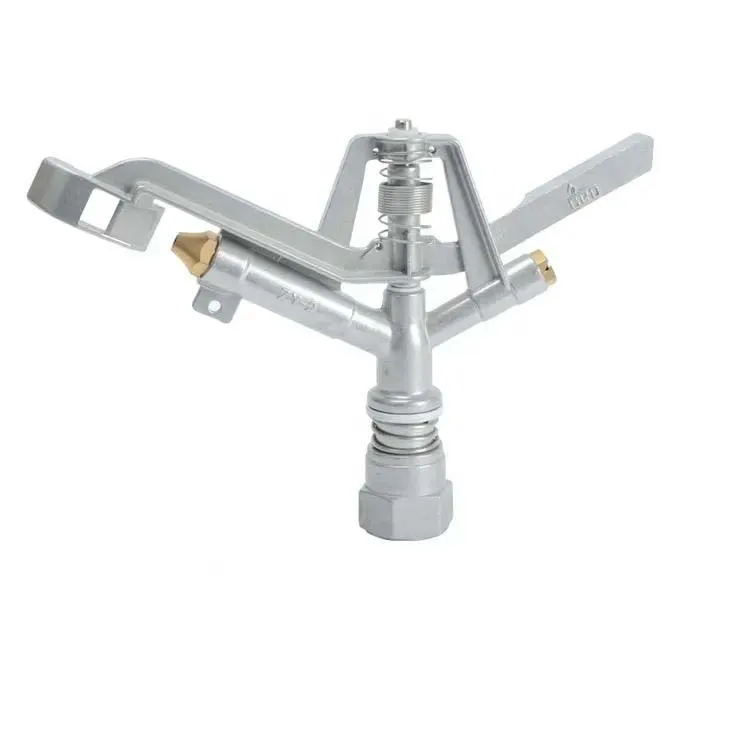
IRRINEX rain gun sprinkler. range: 15-19m; Flow rate: 3-36L/min; pressure: 0.2-0.35bar; number of nozzle: 2. A rain gun is a sprinkler component selected for a defined irrigation layout. Nozzle, connection and operating conditions should be checked together for the chosen model.
IRRINEX irrigation pipe or hose. wall thickness: 0.8mm-4.5mm; diameter: 16mm-75mm; Roll length: 500m/roll. Pipe or hose conveys water between irrigation components. Confirm the actual line type and dimensions before selecting connections or planning an installation.
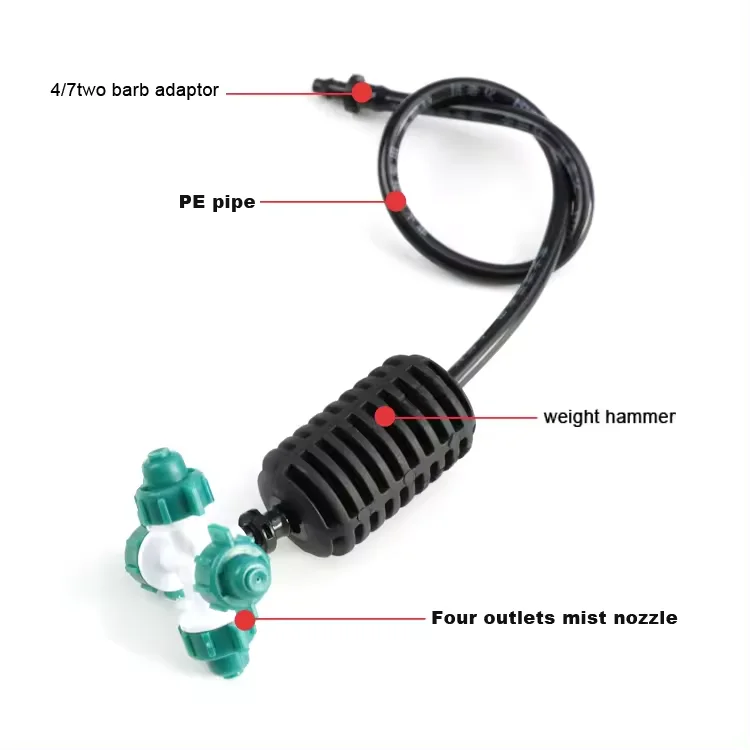
IRRINEX irrigation mist nozzle. sprinkler type: 360 Gear Drive; type: Sprinklers; model number: 5 way. A mist nozzle forms a small-outlet watering component in a selected irrigation arrangement. The actual outlet, connection and operating data should guide configuration choices.

IRRINEX drip irrigation tape. diameter: 16mm 20mm; Diameter: 16mm,20mm; Thickness: 0.2mm,0.3mm,0.4mm,0.5mm; spacing: 10cm,20cm,30cm,40cm,50cm. Drip tape forms a lateral watering component with a selected outlet arrangement. Diameter, wall thickness and emitter options should be checked as one exact configuration.
