Irrigation Management Software Integration: Map Sensors, Units, and Field IDs
Irrigation management software integration succeeds when each incoming value retains its meaning: what was measured, by which sensor, where, in which unit and at what time. A connection that transfers numbers successfully can still assign a deep soil reading to a shallow channel or attach last season’s measurements to a newly divided field. Resolve those mappings before using the combined display to guide irrigation.
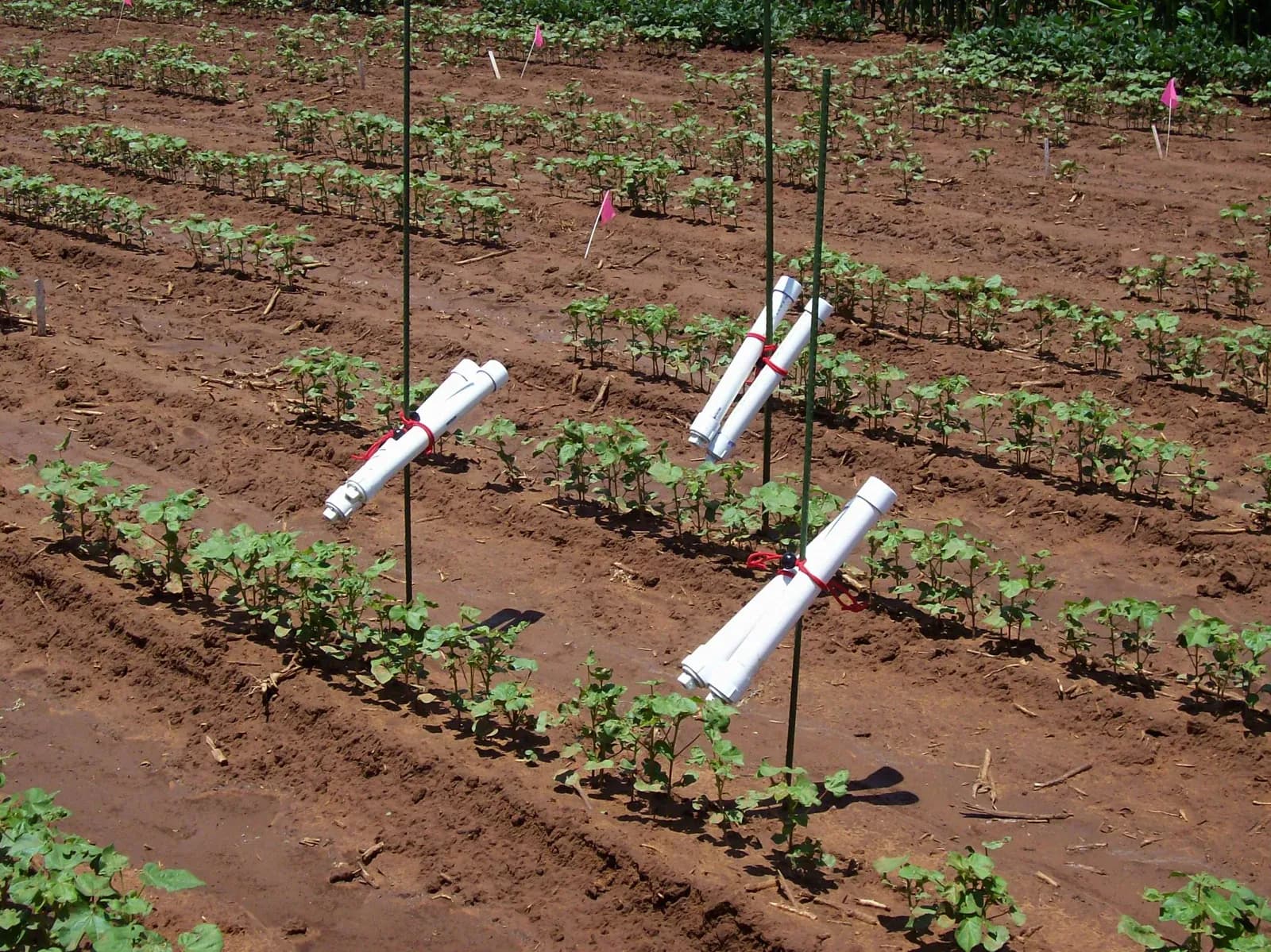
Wireless infrared thermometers measure plant temperature for irrigation scheduling. The photograph shows field instruments, not soil-moisture probes or a demonstrated software integration. Photo: Plant Stress and Germplasm Development Unit, USDA Agricultural Research Service.
This guide develops a practical data dictionary, an original record-mapping exercise and a sensor-replacement history. The field names and records are proposed examples, not an IrriNex software specification or a claim that any platform implements them automatically.
1. Define the measurement before choosing the matching field
Start with one real record from each source. Ask the installer or software supplier to explain every field used by the receiving application. A label such as “moisture” is insufficient: volumetric water content, water tension and a vendor’s relative index describe different quantities. They cannot be combined by changing a column heading.
The OGC SensorThings API Part 1: Sensing, version 1.1 distinguishes the observed property, sensor, observations and feature being observed. Its datastream description includes an explicit unit. That is a useful reference for separating meanings; it does not establish that the farm’s existing products support this standard.
Record the source system, account scope, device identifier, channel, quantity, unit, measurement position and available quality flags. Preserve identifiers as strings when their formatting matters. A device called “007” must not silently become another device called “7”. Neither identifier is necessarily unique across separate customer accounts.
Identify whether each value is an instantaneous sample, an interval average, an interval amount or a cumulative counter. Keep the measurement interval and statistic where applicable. The flow-meter pulse interpretation guide covers the upstream calculation; this integration task preserves its established meaning.
2. Separate field identity, measurement point and physical device
Give a managed field a stable identifier independent of its display name. Keep a separate measurement-point identifier for the location and depth being observed, then associate the installed physical sensor and channel with that point for a defined period. A gateway address or serial number should not become the only surviving description of the sampled soil.
| Record group | Fields to retain | Meaning to verify |
|---|---|---|
| Source identity | source_system, account_id, source_device_id, channel_id | The exact source channel, including its identifier scope |
| Observation identity | source_record_id, source_revision | A measurement’s identity and any documented correction |
| Field assignment | field_id, boundary_version, valid_from, valid_to | Which managed area the assignment described at that time |
| Measurement point | point_id, coordinates, coordinate_reference, depth | Where the measurement applies and the depth reference used |
| Installed sensor | sensor_instance_id, serial, installation_period, calibration_version | Which physical instrument and interpretation were active |
| Quantity and value | observed_property, raw_value, raw_unit, normalized_value, normalized_unit | The quantity before and after a documented conversion |
| Time and quality | measured_at, result_generated_at, received_at, quality, mapping_version | The observation’s timing, suitability and processing history |
A field and an irrigation zone are also different identities. One valve may supply part of a field or several areas, and those relationships may change. Maintain the zone-to-field relationship separately, with its effective period, instead of assuming that matching names establish matching boundaries.
If a field is split, retain the earlier boundary version and create the new identities or documented successor relationships. Do not rewrite the old readings onto today’s map without preserving the original assignment. Coordinates need a stated reference system and coordinate order; a point that plots somewhere plausible can still be wrongly located.
Confirm depth and position with the field team. The soil-moisture sensor placement guide explains why these affect interpretation. Correct software mapping does not make one probe representative of an entire heterogeneous field.
3. Normalize units without losing the original value
Choose a documented receiving unit for each quantity and preserve the raw value alongside it. State the conversion formula and mapping version. A dashboard formatting option is not evidence that the stored values or downstream calculations changed consistently.
For an invented example, suppose source A explicitly reports volumetric water content as a fraction in m³/m³, while source B explicitly reports the same kind of quantity as percent by volume. Then 0.275 m³/m³ × 100 = 27.5% by volume, and 27.5 ÷ 100 = 0.275 m³/m³. These are equivalent unit representations, not a crop target or proof that the instruments agree.
Applying the factor twice would turn 27.5 into 0.00275 m³/m³, a result 100 times smaller than the correct normalized value. That number is still within a broad nonnegative fraction range, so a simple range check would miss the error. Test known input-output pairs as well as checking plausible bounds.
Do not apply this conversion to gravimetric water content, matric potential or an undocumented percentage index. Converting among different physical quantities may require additional information or a model. Record an unknown unit as unresolved rather than borrowing a nearby channel’s setting.
Likewise, preserve the meaning of zero. A valid zero rainfall amount differs from a missing reading; zero soil water content might merit investigation but must not be manufactured from an empty cell. Apply quantity-specific validation and retain the supplier’s quality information.
4. Store measurement time separately from arrival time
Specify which clock created each timestamp. Measurement time describes when the observation applies. Result-generation time describes when its result was produced, which can differ after processing. Receipt time describes arrival at the integration service. OGC’s resultTime is not a generic synonym for server receipt time.
Use an agreed timestamp representation with an explicit UTC reference or numeric offset. IETF RFC 3339, published in July 2002, defines an Internet timestamp format and explains numeric offsets. Retain the original timestamp and offset when normalizing to UTC, and document the farm time zone used for local displays and daily reporting.
For the fictional records below, 2026-08-20T08:00:00-07:00 and 2026-08-20T10:00:00-05:00 both represent 2026-08-20T15:00:00Z. Different clock-face times are not necessarily different instants. Conversely, a repeated local time during a seasonal clock change needs an unambiguous offset or other verified interpretation.
Do not append Z to a local timestamp whose offset is unknown: that declares a UTC time without establishing it. Preserve and hold the ambiguous record for resolution. Some interfaces assign server time when a measurement timestamp is omitted, including the documented SensorThings behavior. A successful import therefore does not prove that an authentic field measurement time was supplied.
Define report periods using explicit start-inclusive, end-exclusive instants. If the task is a local irrigation day, derive those boundaries using the applicable time-zone rules; do not assume that every local calendar day contains the same number of elapsed hours. This concerns record interpretation, not a change to the controller’s watering schedule.
5. Test duplicates, missing values and conflicting records
Agree the observation key with the source supplier. It might combine source system, account and source record identifier; if identifiers are only unique within a stream, include that stream. Timestamp and numeric value alone are inadequate: separate probes can produce identical values at the same instant.
The following six received rows are invented adapter tests. Assume record identifiers are unique within each named source account, A:901 belongs to point P-A and B:901 to a different point P-B. Assume the final row repeats A:901 with a changed value but no documented correction revision. No records in this table represent field measurements.
| Received row | Source content | Expected integration result |
|---|---|---|
| A:901 | 0.275 m³/m³ at 08:00-07:00 on the stated date | One accepted observation at P-A, 15:00Z, normalized to 0.275 m³/m³ |
| A:901 repeated unchanged | Same observation identity and payload | Duplicate receipt; do not add another measurement |
| B:901 | 27.5% by volume at 10:00-05:00 on the stated date | A separate observation at P-B, 15:00Z, normalized to 0.275 m³/m³ |
| A:902 | Missing result with an invalid quality flag | Retain the invalid record; no numeric zero substituted |
| A:903 | 0.280 m³/m³ with local time 08:30 and no established offset | Hold unresolved time; do not guess its UTC position |
| A:901 conflicting copy | 0.310 m³/m³ under the existing identity, without a revision | Preserve both payloads and flag a conflict; no silent overwrite |
Before the conflict arrives, the exercise contains two distinct accepted observations, one duplicate receipt, one invalid record and one unresolved-time record. The sixth row requires the existing A:901 observation to be marked disputed and withheld from uses that require an uncontested value until resolved. It must not become a third independent measurement.
Make repeated import of the same unchanged batch leave the accepted measurement set unchanged while retaining receipt evidence as needed. Test corrected records through an explicit revision policy. Late records may update a historical display, but whether a past recommendation is recomputed must be documented separately.
This exercise tests meaning and identity, not network delivery performance. The irrigation connectivity comparison covers communication paths and arrival measurements. A successful connection cannot resolve an ambiguous observation.
6. Replace sensors without rewriting the past
Keep a persistent measurement point only when its meaning remains appropriate. Replacing a failed probe at the same verified position and depth can continue that point’s history, but the new physical instrument needs its own identity, installation period and calibration record. Moving the probe to another soil or depth requires a new point or an explicitly changed measurement definition.
For a separate fictional replacement at point P-A on 2026-08-21, suppose sensor OLD is assigned until 14:00Z, exclusive, and sensor NEW begins at 15:00Z, inclusive. These are documented installation boundaries for this example, not recommended service times.
| Measurement or period | Arrival information | Historical assignment |
|---|---|---|
| OLD measurement at 13:45Z | Arrives late at 15:20Z | Keep OLD and its applicable calibration; arrival after replacement does not reassign it |
| 14:00Z to 15:00Z | No installed sensor is assigned in this example | Preserve the 60-minute installation gap; do not fabricate continuity |
| NEW measurement at 15:00Z | Arrives at 15:01Z | Keep NEW and its applicable calibration under the continuing point P-A |
Check both physical sensor identity and the assignment effective at measurement time. A delayed message from OLD cannot be converted into a NEW observation merely because the current device register changed. Investigate overlapping assignments or a reading outside its stated installation period.
Show the replacement and calibration boundary in trend reviews. A step in the plotted series may reflect instrument or installation differences rather than an abrupt soil-water change. Keep the original observations; if an authorized correction is justified, retain its method and revision instead of overwriting the only historical copy.
7. Approve the mapping against a small controlled record set
Ask the farm operator, agronomist and integration specialist to review a test set together. Include every required quantity and unit, more than one field, a boundary change, a replacement and the exceptional records above. Trace selected source records through normalization to the final display, checking point, depth, time, value and quality.
Use a non-operating test environment or authorized historical copy. Record the input, expected result, actual result, mapping version, unresolved issue and reviewer. A field-label change should not move past measurements; an unknown channel should remain unresolved rather than being assigned to a default field.
Approve the observation mapping before permitting dependent uses. If the data will inform an alert, verify how invalid, disputed and unresolved records are handled in that separate design. The irrigation alarm worksheet addresses thresholds and response; this mapping exercise supplies correctly identified inputs.
Retest affected cases after an API, firmware, calibration or field-assignment change. Keep the previous mapping version with its effective period. The useful outcome is a traceable path from source record to the correct field observation, with uncertainty still visible.
8. Frequently asked questions
Can I join records using the field name?
Use a stable field identifier and an effective assignment instead. Names can change or be reused, and a field’s current boundary may differ from the boundary relevant to older observations.
Should all soil-moisture values use the same unit?
Compatible quantities can share a documented normalized unit. First confirm what each sensor measures. A percentage index or tension reading does not become volumetric water content through a label change.
Does replacing a sensor require deleting the old channel?
Preserve the old instrument and observations. Associate the replacement with the appropriate measurement point for its own effective period, retain calibration information, and explicitly mark any installation gap or changed sampling meaning.