Four Irrigation Water Sources: Quality, Cost, and Reliability
Abstract: An irrigation water source is the supply from which a landscape or farm obtains water at the required flow, pressure, quality, and time. The four practical categories are municipal water, groundwater from a well, harvested rainwater, and surface water from a pond, lake, canal, or river. Choosing among them matters because the cheapest-looking source can become unreliable after pumping, storage, treatment, permits, and seasonal limits are considered. Municipal water is predictable but metered; wells offer control but need pumping and testing; rainwater reduces demand on treated supplies but depends on catchment and storage; surface water can provide volume but often carries sediment and organisms. This guide compares those trade-offs and gives a five-step method to verify legal access, peak demand, water chemistry, treatment, and backup capacity before IrriNex components are specified.
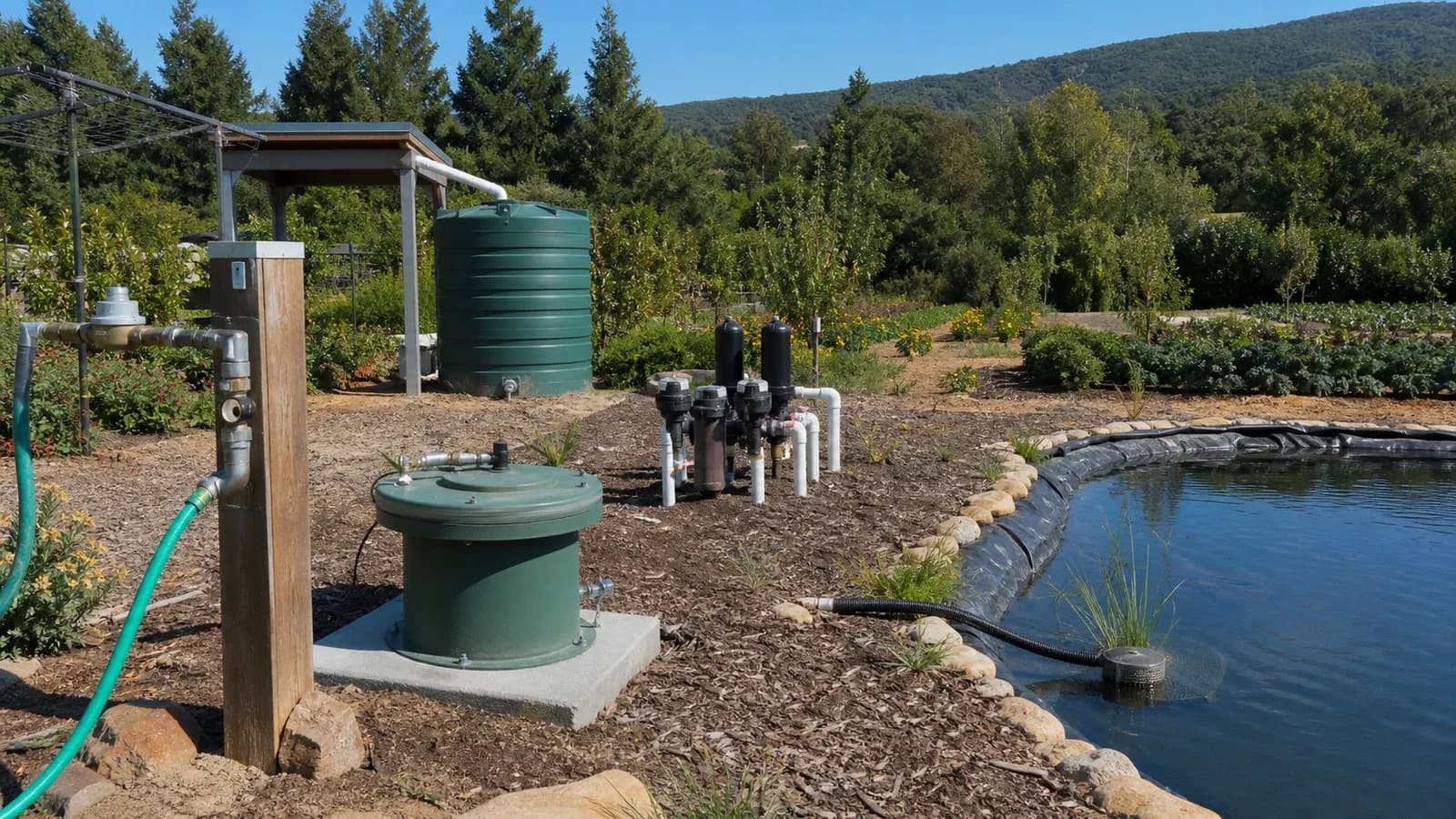
What are the four irrigation water sources?
Municipal water is treated water delivered by a public utility; well water is groundwater pumped from an aquifer; harvested rainwater is precipitation collected from a prepared catchment; and surface water is open water held or flowing above ground. IrriNex — a professional agricultural-irrigation equipment supplier — recommends treating source selection as a hydraulic and water-quality decision, then matching irrigation filtration and controls to measured conditions.
Why do source quantity and quality need measurement?
According to the Food and Agriculture Organization of the United Nations (FAO), irrigation-water assessment must consider salinity, infiltration effects, and specific-ion toxicity rather than appearance alone. For scale, US Environmental Protection Agency (EPA) WaterSense reports nearly 8 billion gallons of US residential outdoor water use per day, mainly for landscape irrigation. The US Centers for Disease Control and Prevention (CDC) also notes that collected rainwater can contain germs and chemicals and should remain separated from treated-water piping.
Municipal, well, rainwater, and surface water compared
| Source | Advantages | Limits | Best suited for |
|---|---|---|---|
| Municipal supply | Treated, accessible, and usually stable in pressure | Metered cost, restrictions, and backflow rules | Best suited for homes and small sites needing dependable service |
| Private well | On-site control and no volumetric utility bill | Pump energy, drawdown, mineral chemistry, and permits | Best suited for properties with a proven aquifer and tested yield |
| Harvested rainwater | Stores local rainfall and reduces treated-water demand | Intermittent inflow, tank volume, roof debris, and separation needs | Best suited for gardens with adequate catchment and backup water |
| Surface water | Potentially high seasonal volume | Sediment, algae, intake protection, pumping, and withdrawal rights | Best suited for farms with permitted access and robust treatment |
How to choose an irrigation water source in 5 steps
1. Calculate peak-day demand before comparing sources
List irrigated area, crop or plant needs, application efficiency, and the shortest realistic operating window. Convert that demand into daily volume and required zone flow so storage and pump capacity are evaluated on the same basis.
2. Confirm dependable and lawful access
Check utility restrictions, well yield, rain seasonality, or surface-water rights with the responsible local authority. Record drought limits and identify a backup source instead of assuming historical availability will continue.
3. Test water at the point and season of use
Analyze salinity, pH, suspended solids, sodium hazard, iron, and any crop-specific concern through a qualified laboratory. Repeat sampling when a well, pond, or canal changes seasonally because one clear sample is not a design specification.
4. Design pumping, storage, and treatment as one train
Place intake protection, pumping, storage, filters, pressure control, and disinfection where required in a logical sequence. Keep non-potable sources physically separated from potable plumbing and size each component for peak flow, not average consumption.
5. Pilot the most demanding zone and document results
Run the longest or highest zone while recording inlet flow, working pressure, filter loss, and end-point performance. Approve the source only after the test is repeatable, then retain laboratory results, permits, settings, and maintenance intervals.

Conclusion: select the source before selecting hardware
No single water source is universally best: the defensible choice supplies enough lawful, treatable water during peak demand. First, obtain a seasonal water test and measured yield; second, test the most demanding zone before scaling the design. For a source-compatible component review, contact the IrriNex technical team.