Technical
Before calculating fertigation nutrients, confirm whether the fertilizer label reports elemental P and K or their oxide equivalents. For a label expressed as N–P2O5–K2O, multiply P2O5 by 0.4364 to obtain P and K2O by 0.8302 to obtain K. Apply the factor to the percentage, mass or concentration on the same basis. Do not convert a value that is already elemental.
A correct multiplication can still give the wrong answer when a recommendation, fertilizer label and water report use different definitions. This guide reconciles those definitions before stock preparation or injection calculations. The grades, quantities and operating volumes below are hypothetical accounting examples, not fertilizer recommendations, mixing instructions or measured farm results.
Many fertilizer grades use three mass percentages in the order total nitrogen, phosphate expressed as P2O5, and potash expressed as K2O. The familiar description “NPK” therefore does not necessarily mean elemental N, P and K percentages. Read the guaranteed analysis and the reporting convention on the actual product. A label language or a product's country of origin is not enough to establish that convention.
Reporting as an oxide equivalent is a bookkeeping convention. It does not mean the bag contains free phosphorus pentoxide or potassium oxide, nor does it identify the exact chemical compounds supplying the nutrients. Obtain the complete analysis for secondary nutrients, micronutrients, solubility declarations and other relevant specifications. Do not describe the percentage left after the three grade numbers as “inert filler”: the remaining mass can include other elements within fertilizer compounds, moisture and additional nutrients.
The first number usually states total N on the specified basis. Nitrate-N, ammonium-N and urea-N describe nitrogen forms; their declared shares may be components of that total. Do not add the total and its components together. Nor should a percentage reported as nitrate ion be treated as nitrate-N without checking the laboratory definition. The broader fertigation equipment and operating guide provides context for where this accounting enters the irrigation process.
The conversion factors below follow UF/IFAS guidance on nutrient stewardship in fertigation. They express the mass of the element within the stated oxide equivalent. Choose one direction, label both columns and keep the same units on each side.
| Starting value | Required value | Calculation |
|---|---|---|
| P2O5 | Elemental P | P = P2O5 × 0.4364 |
| K2O | Elemental K | K = K2O × 0.8302 |
| Elemental P | P2O5 equivalent | P2O5 = P ÷ 0.4364 |
| Elemental K | K2O equivalent | K2O = K ÷ 0.8302 |
For example, a hypothetical 20-10-20 product on an N–P2O5–K2O mass basis contains 20% N, 10 × 0.4364 = 4.364% elemental P, and 20 × 0.8302 = 16.604% elemental K. Converting the reporting basis changes the numbers used in the nutrient account; it does not change the product or create additional nutrients.
The reverse multipliers are approximately 2.2915 for P and 1.2045 for K. In a worksheet, divide by the same forward factors instead of repeatedly using rounded reverse multipliers. Carry calculation digits until the final result, then round to a precision justified by the label, weighing and volume measurements. Extra calculator digits do not increase the certainty of a guaranteed analysis.
For a dry product with mass percentages, nutrient mass equals product mass multiplied by the nutrient fraction. Convert an 8% guarantee to 0.08 before multiplying. When the guarantee is an oxide equivalent, apply its elemental conversion once. Keep the original guarantee beside the converted result so a reviewer can trace every step.
| Label component | Mass on label basis | Elemental nutrient mass |
|---|---|---|
| 12% total N | 25 × 0.12 = 3.0000 kg N | 3.0000 kg N |
| 8% P2O5 | 25 × 0.08 = 2.0000 kg P2O5 equivalent | 2.0000 × 0.4364 = 0.8728 kg P |
| 24% K2O | 25 × 0.24 = 6.0000 kg K2O equivalent | 6.0000 × 0.8302 = 4.9812 kg K |
The product mass is 25 kg; neither 2 kg P2O5 equivalent nor 0.8728 kg P is another quantity of fertilizer to add. They describe the same phosphorus content on two bases. Calling the 2 kg figure elemental P would overstate P by about 2.29 times. The corresponding K overstatement would be about 1.20 times. These errors persist through an otherwise correct dilution calculation.
A litre is a volume, not a kilogram. Suppose a hypothetical liquid is guaranteed as 7-4-9 by mass and has a specified density of 1.22 kg/L at the relevant conditions. One litre therefore contains 1.22 kg of product. Calculate each nutrient from that mass, then convert P2O5 and K2O to the elements.
| Component | Calculation on label basis | Elemental result per product litre |
|---|---|---|
| N | 1.22 × 0.07 × 1000 = 85.4 g | 85.4 g N |
| P2O5 | 1.22 × 0.04 × 1000 = 48.8 g | 48.8 × 0.4364 = 21.29632 g P |
| K2O | 1.22 × 0.09 × 1000 = 109.8 g | 109.8 × 0.8302 = 91.15596 g K |
Working results can be reported as about 21.30 g P and 91.16 g K per litre, subject to the precision of the input data. If 4% instead means mass per volume, such as 4 g per 100 mL, that is 40 g/L on the stated nutrient basis; multiplying it by density again would be wrong. Confirm the units with the supplier when the guarantee is ambiguous. Do not borrow the density of water or another fertilizer.
Also distinguish the original liquid product from a diluted stock made from it. Product density and nutrient percentage do not automatically describe the new stock. Record the amount of product used and the final stock volume, or use an appropriately verified concentration for the actual mixture.
Consider 100 L of final stock containing 150 g of the hypothetical 12-8-24 product per litre. Product mass is 100 × 150 = 15,000 g, or 15 kg. This states an accounting concentration, not proof that the product dissolves safely at that concentration. Adding fertilizer to 100 L of water is not necessarily the same as preparing a final stock volume of 100 L.
Assume the stock is homogeneous, all 100 L actually enters the irrigation line, no nutrient remains in the tank or transfer lines, and no nutrient is lost by precipitation, leakage or another route. For the following calculation, 300 m3 is the measured total mixed-water volume at the accounting boundary over the entire event, including the stock volume. If the available meter reads only upstream carrier water, record that basis and account for the added stock volume when a final-mixture concentration is required.
| Nutrient | Elemental mass entering the event | Flow-weighted event mean added concentration |
|---|---|---|
| N | 15 × 0.12 = 1.80000 kg | 1.80000 × 1000 ÷ 300 = 6.0000 mg/L |
| P | 15 × 0.08 × 0.4364 = 0.52368 kg | 0.52368 × 1000 ÷ 300 = 1.7456 mg/L |
| K | 15 × 0.24 × 0.8302 = 2.98872 kg | 2.98872 × 1000 ÷ 300 = 9.9624 mg/L |
The unit shortcut is useful: 1 kg/m3 = 1000 mg/L. Rounded event additions are about 1.746 mg/L P and 9.962 mg/L K. They are not instantaneous outlet concentrations, concentrations at every emitter, or crop uptake. A short injection window within a longer irrigation event can produce a much higher concentration during injection than the whole-event mean.
If only 80 L of the uniform stock is actually transferred, its nutrient contribution is 80% of the full-stock mass, before accounting for other losses. A tank's nominal capacity or a planned pump run time cannot establish transferred mass. Record actual stock draw and the corresponding water volume. Add source-water nutrients and other fertilizer contributions separately on a consistent elemental basis. Once the nutrient account is correct, use the separate guide to calculate the injection rate from the nutrient target.
Suppose an approved recommendation specifies 1.00 kg elemental P for a defined area and event. That corresponds to 1.00 ÷ 0.4364 ≈ 2.2915 kg P2O5 equivalent. A 12-8-24 product would theoretically supply it with 1.00 ÷ (0.08 × 0.4364) ≈ 28.64 kg of product. This example only translates a stated target; it does not establish that the target or the accompanying N and K additions are appropriate.
Keep separate columns for label basis and elemental basis. If the recommendation already states kg P2O5, compare it directly with the P2O5 guarantee, or convert both sides once. If a water laboratory reports mg/L as P, do not multiply that result by 0.4364 again. Results expressed as phosphate, phosphate-P, dissolved P or total P require their own definitions; the oxide conversion is not a substitute for identifying the analyte and sampling method.
A soil-test extraction result is also not automatically a mass of fertilizer to inject. Obtain the associated agronomic interpretation. For combined nutrient budgets, use contributions relevant to the same area, time period and water-volume boundary. Otherwise a correct unit conversion can conceal mismatched accounting periods.
| Record block | What to retain |
|---|---|
| Product identity | Product, lot, label image, complete guaranteed analysis and date |
| Reporting basis | Mass/mass or mass/volume, elemental or oxide, and nitrogen-form definitions |
| Density | Value, units, temperature or specified conditions, and evidence source for liquid products |
| Approved target | Nutrient, basis, units, area, event or period, and agronomic reference |
| Preparation | Weighed product mass, converted nutrient fractions and final stock volume |
| Transfer | Actual stock volume drawn, remaining stock, meter readings and water-volume boundary |
| Mass balance | Each product's N, P and K, source-water contribution, other inputs and stated loss assumptions |
| Review | Unrounded workings, rounded operational result, reviewer, date and outstanding checks |
Separate input cells from formula cells and write the unit in each heading. A reviewer should be able to reproduce the answer from the retained label and measurements without knowing which convention the first operator assumed. A blank density or an unidentified nutrient basis is a reason to resolve the input, not a reason to insert a convenient default.
| Error | Consequence | Correction |
|---|---|---|
| Calling P2O5 or K2O elemental P or K | Overstates the elemental nutrient mass | Convert once and label both bases. |
| Multiplying product mass by 8 instead of 0.08 | Creates a hundredfold percentage error | Use grade percentage divided by 100. |
| Treating litres as kilograms | Misstates liquid product mass | Use verified density for a mass-based guarantee. |
| Using tank capacity as final stock volume | Misstates stock concentration | Measure final prepared volume. |
| Assuming the entire tank was injected | Overstates delivered nutrients | Measure actual stock draw and account for retained liquid. |
| Using ppm as mg/L for concentrated stock | Confuses mass fraction with volume concentration | State the ppm definition and use density where needed. |
| Ignoring other fertilizers or source water | Undercounts the combined nutrient input | Sum matching elemental contributions. |
| Rounding every intermediate value | Accumulates avoidable numerical drift | Carry working precision and round the final result. |
| Mixing US and imperial gallons | Uses different volumes under the same word | Name the gallon convention and convert consistently. |
Conversion verifies nutrient bookkeeping. It does not prove that a grade is suitable for the crop, dissolves at the intended temperature, mixes safely with another product or remains compatible with source water. Confirm stock-solution solubility and compatibility separately. The examples above are not instructions to combine fertilizers or acids.
Likewise, an EC reading cannot identify how much P or K is present. It reflects the overall electrical response of the solution and needs an appropriate interpretation. Follow the separate procedure for EC and pH sensor calibration and verification. Injector delivery, irrigation distribution and the agronomic nutrient plan each remain distinct checks.
Not when its basis is N–P2O5–K2O. It supplies 10% N, 4.364% P and 8.302% K by mass. Equal printed grade numbers represent equal percentages on their stated reporting bases.
First confirm that the laboratory means elemental P and identify the units and analytical fraction. If it already reports elemental P, the P2O5-to-P conversion does not apply. Ask for clarification if the heading is incomplete.
It can reveal how much nutrient a stated quantity contributes. Selection still requires the crop and soil or substrate assessment, water analysis, other nutrient inputs and practical compatibility. Keep those decisions separate from the arithmetic.
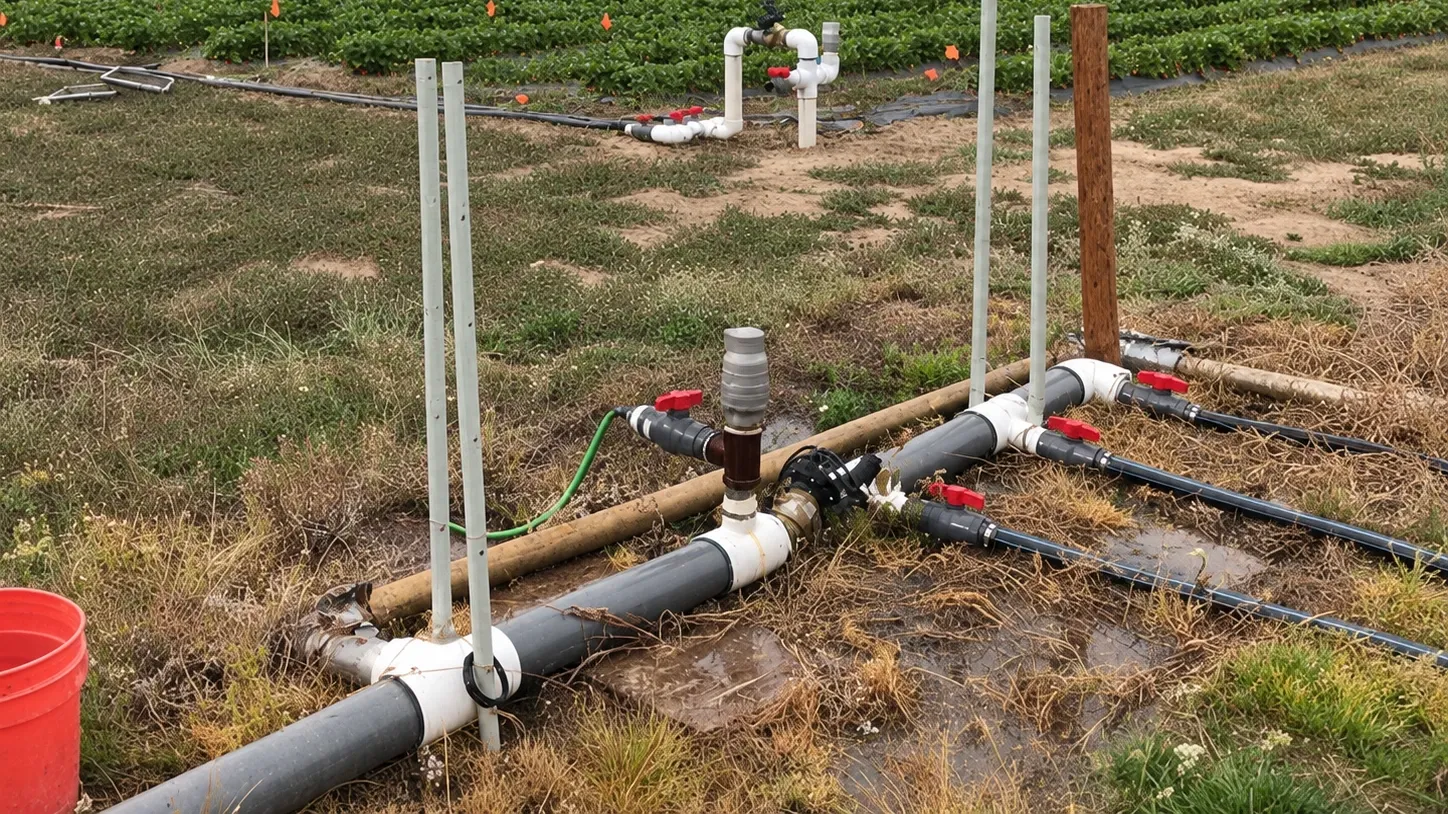
Fertigation field photograph: Javier Fernandez-Salvador, Oregon State University. Light AI restoration, orientation correction and crop; the equipment scene does not depict the hypothetical nutrient calculations.
Products relevant to this irrigation guide.
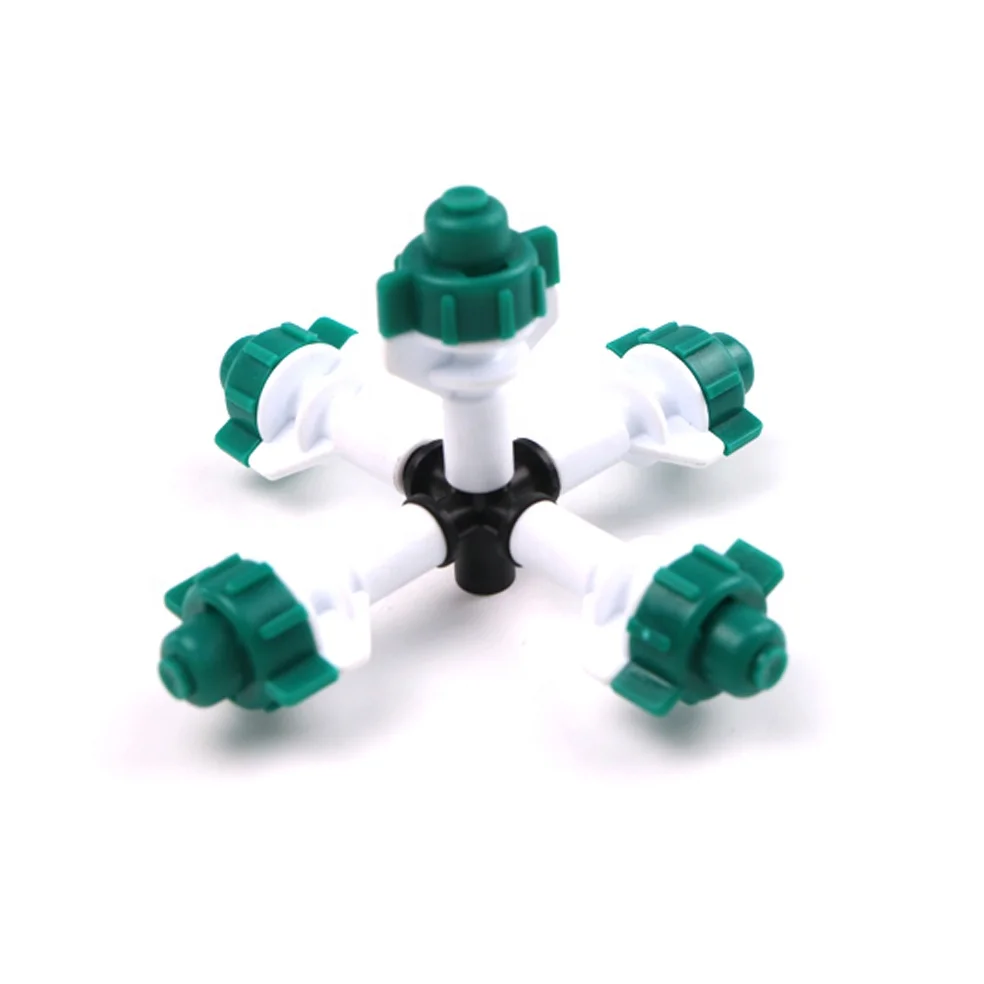
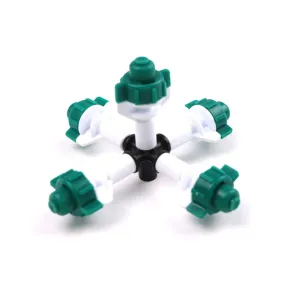
IRRINEX irrigation mist nozzle. Diameter: 1mm; Nozzle: 0.6mm; Flow rate: 10-50L/H; Working Pressure: 0.15-0.3mpa. A mist nozzle forms a small-outlet watering component in a selected irrigation arrangement. The actual outlet, connection and operating data should guide configuration choices.

IRRINEX irrigation sprinkler or nozzle. Adapter Size: 1/2" F. A sprinkler or nozzle is selected to distribute water at a defined irrigation point. Confirm the actual product form, connection and available operating data for this listing.
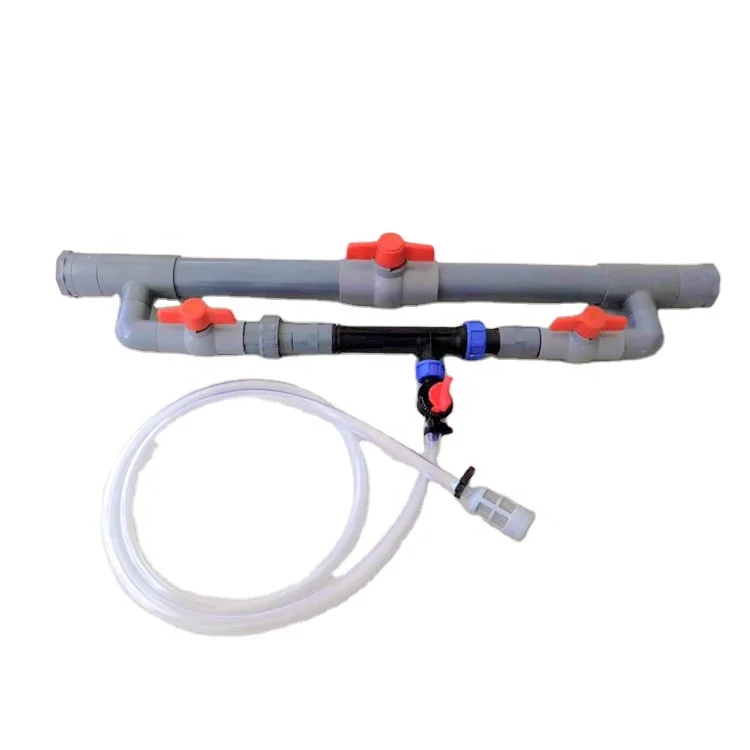
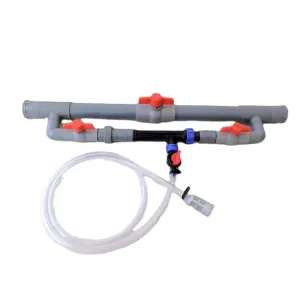
IRRINEX Venturi fertilizer injector. Diameter: 1"-4"; Max Flow Rate: 20mm³/h; Max Pressure: 8Bar. A Venturi injector is used to introduce a liquid feed into irrigation water through a suitable injector arrangement. Select the connection and confirm the operating conditions needed for the exact injector.
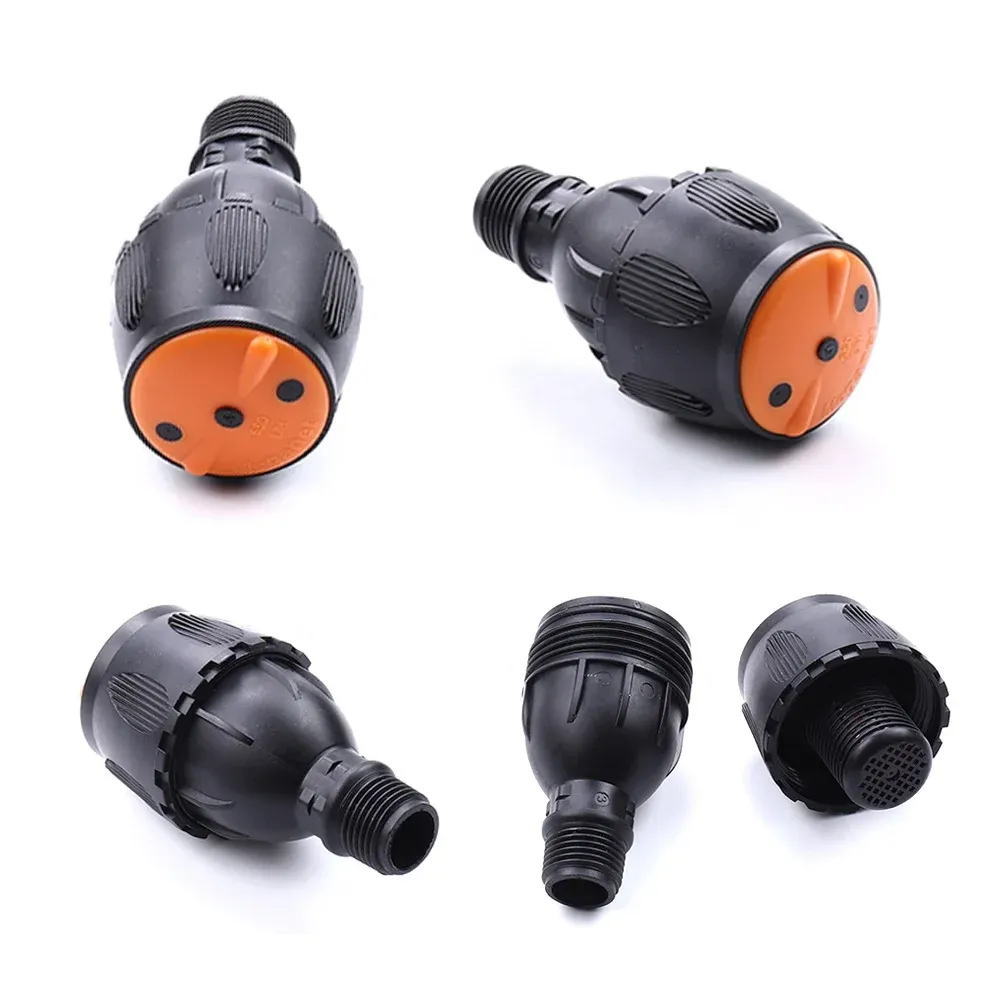
IRRINEX irrigation sprinkler or nozzle. Diameter: M1/2", M3/4"; Working Pressure: 2-3bar; Spraying Radius: 7-9m; Flow Rate: 550L/h, 1100L/h. A sprinkler or nozzle is selected to distribute water at a defined irrigation point. Confirm the actual product form, connection and available operating data for this listing.