Common Problems With PVC Ball Valves and How to Prevent Them
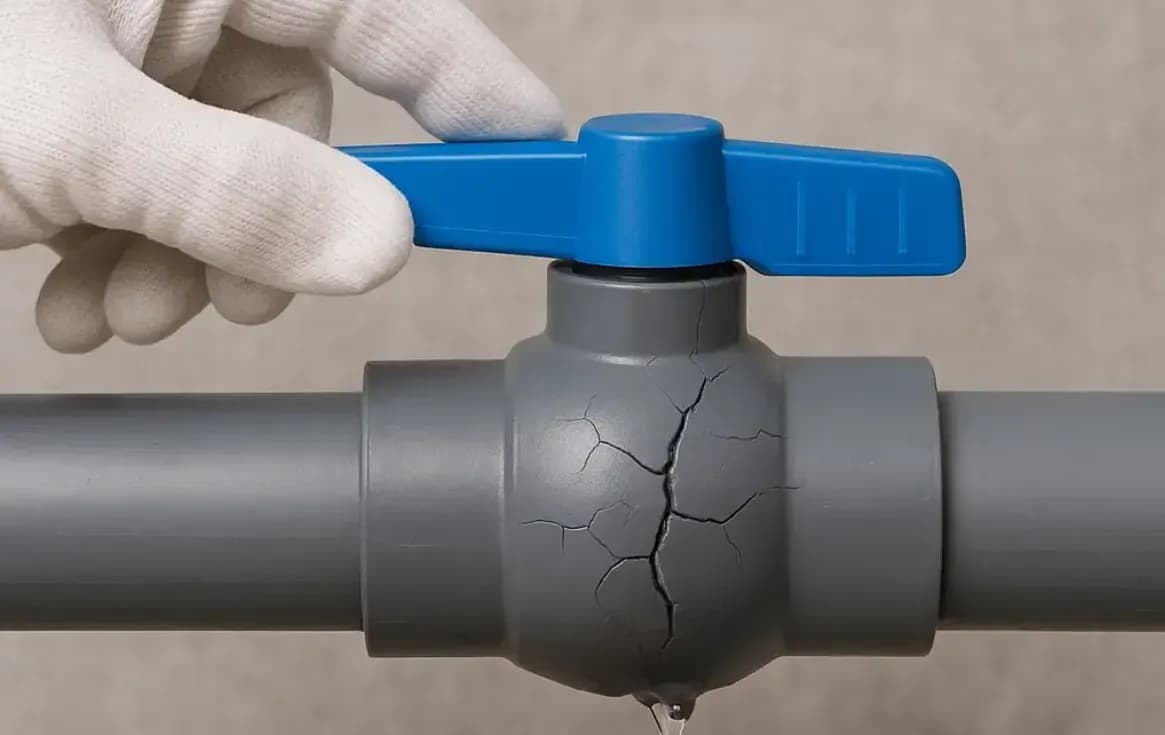
Summary: PVC ball valve problems usually come from material limits, worn internal parts, or poor installation. PVC ball valves are quarter-turn shutoff valves made from polyvinyl chloride, a lightweight plastic used in irrigation and water systems because it resists corrosion. They fail when UV light makes the body brittle, incompatible chemicals soften the plastic, high temperature lowers pressure strength, seals wear, debris jams the ball, or threaded joints are over-tightened. According to common PVC pipe and valve manufacturer data, many PVC valves are rated at 73 deg F and must be derated as temperature rises; most standard PVC ball valves should not be used above 140 deg F (60 deg C). Understanding these limits prevents leaks and sudden valve failure.
Why PVC ball valves fail
A ball valve uses a drilled ball that turns 90 degrees to open or stop flow. The design is simple, but the valve body, stem, seals, and seats all have service limits. When any of those limits are ignored, leaks or stiff operation follow.
In irrigation manifolds, PVC or PP ball valves often sit near filters, fertigation points, and zone valves. For replacement options, see IrriNex ball valves and irrigation valves.
Material degradation in PVC ball valves
UV exposure and brittleness
Sunlight breaks down exposed PVC over time. The body may discolor, chalk, and eventually crack, especially where the valve is unsupported or under pipe stress.
Chemical incompatibility
PVC does not tolerate all chemicals. According to PVC chemical-resistance guidance from the Plastics Pipe Institute, solvents such as ketones, aromatics, esters, and some ethers can soften or attack PVC.
Temperature extremes
Heat reduces pressure capacity, while freezing makes PVC more brittle. A valve rated at room temperature is not automatically safe at higher water temperatures or after a freeze.
Operational and mechanical problems
Seal and O-ring wear
EPDM, Viton, and PTFE seals can wear from frequent cycling, sediment, heat, or chemical exposure. Worn seals cause seepage around the ball or stem.
Stem stripping or breakage
The stem connects the handle to the ball. It strips when the user forces a stuck valve or uses a tool for extra torque.
Ball sticking
Scale, sand, and long periods without use can make the ball hard to turn. A stuck ball should be cleaned or replaced, not forced.
Installation mistakes that cause leaks
- Over-tightening threaded joints. PVC threads need sealant tape and controlled torque. Too much force cracks the female socket.
- Leaving pipe unsupported. Sagging pipe puts bending stress on the valve body and unions.
- Ignoring pressure ratings. PVC valves are rated for water, not compressed air or gas. Standard PVC should not be used for compressed air service.
- Skipping upstream filtration. Sediment scratches seats and jams the ball. Use an appropriate filter from the IrriNex irrigation filters range.
PVC ball valve problem comparison
| Problem | Cause | Best response | Suitable for |
|---|---|---|---|
| Brittle cracked body | UV, freeze, or over-tightening | Replace valve and add protection | Suitable for outdoor irrigation lines |
| Leak at stem | Worn packing or O-ring | Replace serviceable seal or valve | Suitable for manifolds with frequent operation |
| Hard-to-turn handle | Scale, debris, or seat sticking | Flush, clean, or replace valve | Suitable for hard-water and seasonal systems |
| Thread leak | Wrong tape, poor alignment, too much torque | Reinstall with correct support and sealant | Suitable for installers working with PVC threads |
5 steps to prevent PVC valve failure
Step 1: Check temperature and pressure ratings
Read the manufacturer curve, not only the size label. Derate pressure when water temperature rises.
Step 2: Support the pipe on both sides
Pipe hangers or brackets stop the valve from carrying pipe weight. This reduces cracking at threaded and union joints.
Step 3: Use controlled hand torque
Apply PTFE tape and tighten carefully. Stop when resistance rises instead of forcing another turn.
Step 4: Keep debris out
Install filtration before the valve when water carries sand, algae, or scale. See the IrriNex filter selection guide.
Step 5: Operate the valve periodically
Turn seasonal valves every few months. Regular movement prevents the ball from bonding to the seats.
Bottom line
PVC ball valves are dependable when they stay within their pressure, temperature, chemical, and installation limits. Replace any valve with a cracked body, swollen plastic, stripped stem, or persistent leak. For irrigation systems, specify the valve together with filtration and pipe support, not as an isolated part. Browse IrriNex ball valves, barb valves, and mini valves.