What Is a Venturi Fertilizer Injector — and Why Does It Work So Well?
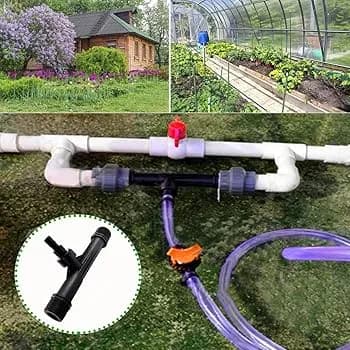
If you run any drip or sprinkler system, you've probably faced this question at some point: how do I get fertilizer into the line without buying an expensive pump? The Venturi injector is where most growers land, and once you understand how it works, the appeal is obvious.
The physics behind it go back about 200 years. The core design is a smooth-walled tube with a sharp constriction at the center. At that point, water speeds up and static pressure drops — enough to create a real vacuum. A small inlet at the vacuum point connects to your fertilizer tank. The fertilizer gets pulled in, not pushed. No motor, no power source, no moving parts beyond a small backflow-prevention ball in the suction inlet.
How the pressure differential works
Water enters the injector and passes through a narrowed channel, picking up velocity and losing pressure. That pressure drop creates a vacuum at the suction port. A differential of around 25% between inlet and outlet is enough to start drawing fertilizer; a larger gap means stronger suction. Maximum draw typically happens around 50%.
This is also where most installation headaches originate. The outlet pressure needs to be at least 25–30% lower than the inlet for suction to work. Dropping the injector into a pressurized mainline doesn't automatically produce that differential — you need to build it deliberately, usually through a bypass assembly that creates enough restriction on the outlet side.
Why the bypass matters
Most installers prefer the bypass over direct inline installation, and the reason is straightforward: a Venturi is a constriction, and a constriction in your mainline robs pressure from your emitters. A bypass routes a small controlled stream through the injector while the majority of your flow continues unimpeded.
Injector size matters here too. Too large and it won't draw at all; too small and it throttles your system. Sizing from the actual flow rate of your irrigation zone — not your supply line — is the only reliable approach.
What it does well, and where it falls short
No electricity. No pump. It runs entirely on existing line pressure. For small to mid-size operations, that's a significant practical advantage — both in upfront cost and in ongoing maintenance.
The tradeoff is precision. Dosing pumps inject with controlled precision and maintain constant pressure, which matters at commercial scale. Venturi systems introduce some pressure loss and offer less fine-grained control over injection rate. If you're managing precise nutrient ratios across multiple crop types, a dosing pump is the better fit. For most farms, greenhouses, and garden systems, the Venturi is good enough — and good enough here is genuinely good.
Installation and maintenance
Mount the injector horizontally or with the outlet facing up. Use full-flow isolation valves at least the same diameter as the injector ports — undersized valves create backpressure that fights the pressure differential you're trying to maintain.
After every fertigation run, flush with clean water. Residue and mineral buildup in the suction port are the most common reason injectors stop working. If yours isn't drawing after a flush, check two things first: the gasket condition and container height. A lower fertilizer container requires more vacuum to pull the solution up the suction tube — elevating it reduces the demand on the injector.
It's not a complicated piece of equipment. It's a shaped tube that exploits a pressure difference. That simplicity is the whole point — fewer components, fewer ways for it to go wrong.