Water Sources for Small-Scale Irrigation and Greenhouses
Abstract: A water source for small-scale irrigation is the complete supply that can meet a farm or greenhouse’s peak daily demand at usable quality and pressure, not simply a nearby well, pond, or tap. Planning it matters because a small area can still require long continuous pumping during hot, dry weather, while a short irrigation window demands greater instantaneous flow or storage. This guide compares a dedicated well, managed surface water with storage, and municipal, rainwater, or combined supplies. It follows demand calculation, low-season yield testing, laboratory quality assessment, pump and filtration design, buffer storage, commissioning, and contingency planning. Michigan State University Extension (a public agricultural education service) reports a regional peak-use example of 0.25–0.30 inches per day in Michigan and Indiana, equivalent to roughly 5–7 gallons per minute per acre when pumping continuously. Use local crop data and the five steps below to size your own system.
What makes a small irrigation water source adequate?
IrriNex (a professional agricultural irrigation systems and component supplier) calls a source adequate only when dependable yield, water quality, legal access, power, and distribution capacity overlap during peak demand. Buffer storage is a tank or pond that accumulates water at the source rate and releases it at the higher zone rate, reducing the need to oversize a weak but steady source.
Michigan State University Extension (the university’s public agricultural education service) notes that small greenhouse and field systems need similar peak capacity. Its Michigan and Indiana example links 0.25 inches/day to about 5 gpm/acre and 0.30 inches/day to about 7 gpm/acre if pumping 24 hours; halving available pumping time approximately doubles required capacity.
Compare three small-scale supply options
| Supply | Advantages | Limitations | Best suited for |
|---|---|---|---|
| Dedicated irrigation well | Compact and usually steady; water is available on demand | Drilling, drawdown, sand, minerals, and continuous-duty pump cost | Best suited for sites with a tested productive aquifer and reliable power |
| Surface water plus buffer pond or tank | Storage covers short peak flows and can reduce pump size | Seasonal yield, sediment, algae, pathogens, and evaporation | Best suited for permitted farms with monitored dry-season recharge |
| Municipal, harvested rainwater, or combined supply | Flexible backup and staged investment | Tariffs, restrictions, rainfall variability, and more controls | Best suited for small protected-crop sites where continuity outweighs complexity |
Plan a small irrigation supply in five steps
1. Calculate peak daily and zone demand
Convert crop water use into daily volume for the irrigated area, then divide by the actual pumping and irrigation hours rather than 24 hours automatically. Separately total emitter flow in the largest zone, because daily source capacity and instantaneous manifold flow are different design checks.
2. Prove source yield in the limiting season
Conduct a sustained well test, dry-season stream measurement, pond recovery test, or municipal flow and pressure check for at least the expected duty cycle. Confirm permits and record how drought, neighbouring users, low tank level, or domestic demand can reduce usable supply.
3. Test water quality and food-safety risks
Sample at the source and test salinity, pH, sediment, hardness, iron, manganese, nutrients, and relevant microorganisms through a qualified laboratory. The Food and Agriculture Organization of the United Nations water-quality guidance (FAO’s agricultural reference) stresses that results must be interpreted with crop, soil, climate, drainage, and field conditions.
4. Size pump, storage, treatment, and power together
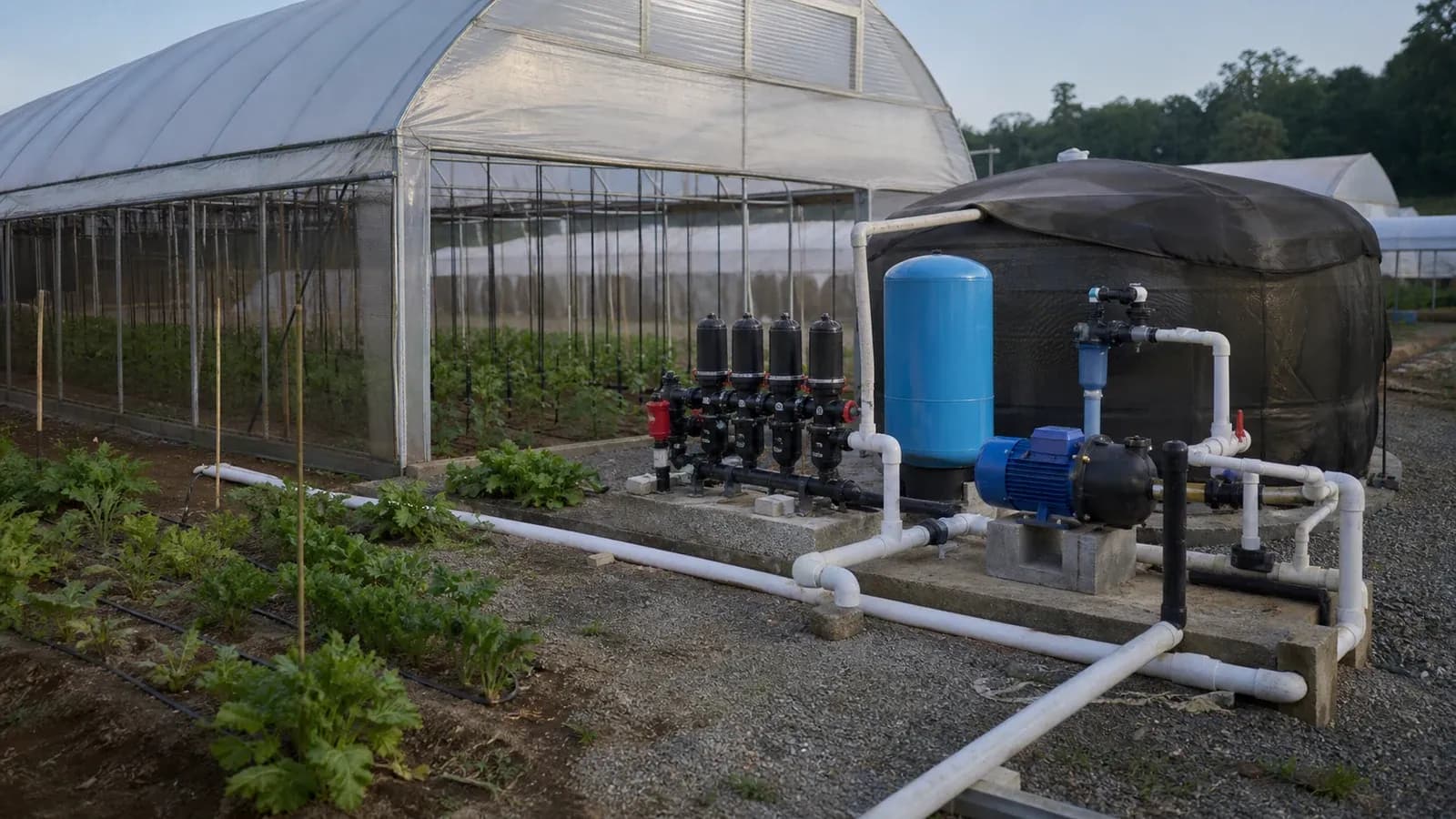
Calculate pump duty from source rate, lift, friction, treatment loss, field pressure, and irrigation window, then select continuous-duty equipment and safe electrical supply. Use covered storage where appropriate, accessible irrigation filtration, pressure control, and isolation and check valves rather than treating each item as a separate purchase.

5. Commission, monitor, and reserve emergency water
Flush the drip network, verify pressure and flow at the farthest outlets, time tank drawdown and refill, and test low-level and pump protection before crops depend on it. Record daily meter values and keep an emergency volume, second source, or response plan sized to the crop’s maximum tolerable interruption.
Conclusion: plan the source before the greenhouse manifold
Small scale does not remove peak demand, water-quality, or continuous-duty requirements; it only narrows the margin for expensive redundancy. Action 1: calculate daily litres and largest-zone litres per minute on separate lines of the worksheet. Action 2: give those values, source test, analysis, and elevation to the IrriNex technical team before specifying pump, tank, filtration, and pipe.