Smart Irrigation System Data Ownership: Questions to Ask Before Choosing a Platform
Before choosing a smart irrigation system, establish what farm data you can retrieve, who can use it, and what happens when the service ends. A statement that the data belongs to the farmer is useful only when the agreement and the working software make the relevant rights and access clear. Test an export before committing years of irrigation history to a platform.
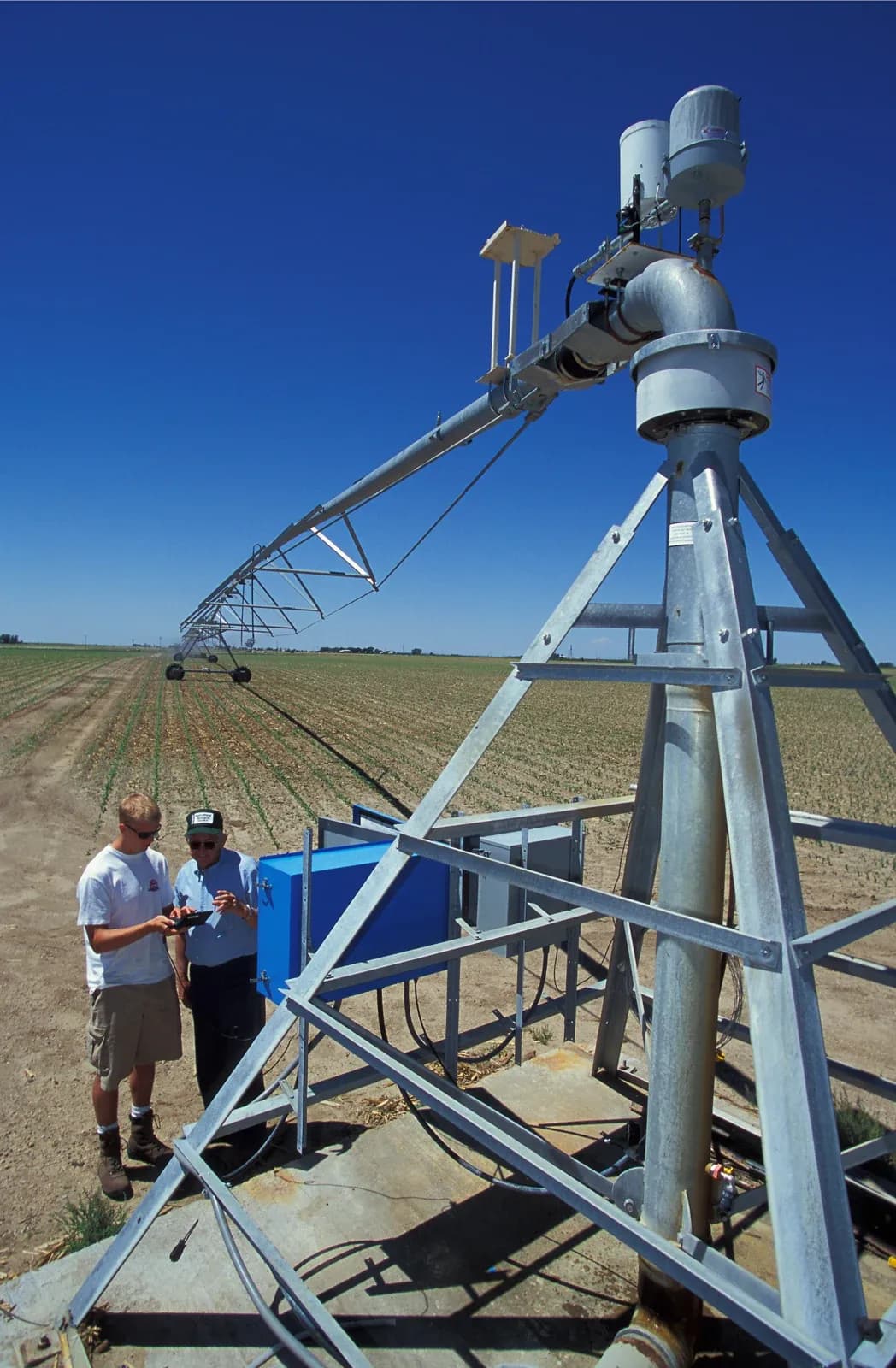
Center-pivot irrigation equipment with researchers recording movement data. This historical field photograph does not demonstrate the data-export or access-rights checks in this guide. Photo: Scott Bauer, USDA Agricultural Research Service.
This guide turns those questions into a procurement record, an original export-completeness example and a practical exit exercise. It addresses operational evidence to request from a supplier. Ownership and contract interpretation depend on the agreement and applicable law; have the relevant terms reviewed for the farm's circumstances.
1. Define which irrigation data the agreement covers
Start with the records the farm actually needs to manage water and explain past decisions. Raw sensor measurements, calculated recommendations, valve events and operator changes are different categories. A promise to export reports may cover only a subset of them.
Give the supplier a data inventory with a sample of each required record. Ask whether the farmer can view, retrieve, share and retain that category, both during service and after cancellation. Also establish which permissions the supplier receives and whether those permissions differ for operating the service, producing aggregated analysis or other uses.
| Data category | Irrigation example | Evidence to request |
|---|---|---|
| Field measurements | Soil moisture, pressure and flow readings | Original available interval, quality status and export sample |
| Operating events | Valve starts, stops, alarms and manual interventions | Event history with distinctions between requests and observations |
| Configuration history | Programs, thresholds and calibration changes | Available versions and identification of changes |
| Field context | Block boundaries, sensor locations and device assignments | Usable accompanying records that preserve meaning |
| Derived information | Recommendations, summaries and calculated indicators | What is included, its documentation and any separate restrictions |
University of Maryland Extension's Farm Data: Ownership and Protections, originally published in 2017 and updated online in 2022, frames farm-data arrangements around rights and responsibilities and raises portability and sharing questions. Use those questions as background; its historical discussion does not establish today's law for every farm.
Include the farm operator, landowner and relevant service partners in the discussion where their interests differ. Paying for a sensor, leasing a field and administering an account are separate facts. Record the agreed parties and covered data rather than inferring permissions from who initially installed the app.
2. Ask for usable records, not just a downloadable report
Request an export from a representative demonstration account containing several blocks and a period with ordinary irrigation events. Open it outside the supplier's dashboard. Determine whether it is suitable for the task the farm wants to perform: archive an event history, analyze a season or transfer information to another system.
A PDF chart can be a useful human-readable report, but it is not equivalent to a file containing individual measurements. Likewise, a spreadsheet of daily averages cannot reconstruct every original reading. Specify the required resolution and categories rather than treating a familiar filename extension as proof of completeness.
NIST SP 800-144, published in 2011 for public-cloud security and privacy, treats usable data export, metadata and planned service exit as important outsourcing considerations. Here those are background principles for procurement, not a claim that a farm platform is certified or must follow federal-agency rules.
Ask the supplier to include a readable explanation of the exported fields, the selected period and any excluded records. Record export limits, required subscription level, assistance charges and the time needed to obtain a complete copy. A feature that requires a support request may still be workable if the process and delivery commitment meet the farm's needs.
For soil measurements, retain enough field context to understand the records later. The soil-moisture sensor placement guide explains why location and depth affect interpretation. A long column of numbers without that context can have limited value to the next agronomist.
3. Run an export-completeness check with explicit assumptions
Consider an original, fictional acceptance exercise with 24 measurement channels, one expected record per channel every 15 minutes and 14 complete 24-hour days. Use an agreed UTC period including its start and excluding its end, with no planned sampling changes. Each channel has 96 expected records per day, so the full grid contains 24 × 96 × 14 = 32,256 expected records.
This is an expected sampling grid, not evidence that the field devices produced every reading. Keep source availability separate from export completeness. If a sensor was disconnected, the correct export may preserve a documented gap rather than inventing a measurement.
| Check | Record count | Interpretation |
|---|---|---|
| Expected sampling grid | 32,256 | 24 channels × 96 daily times × 14 days |
| Rows in the received measurement file | 32,252 | A raw file count, before checking its contents |
| Repeated rows beyond the first valid occurrence | 240 | Duplicates within the agreed period in this example |
| Rows outside the requested period | 20 | A separate group, with no overlap with the duplicate count |
| Unique, in-period expected positions represented | 31,992 | 32,252 − 240 − 20 |
| Expected positions without a reading | 264 | 32,256 − 31,992 |
For this illustration, assume every remaining row belongs to a recognized channel and expected sampling position. Coverage is then 31,992 ÷ 32,256 × 100, or approximately 99.18 percent. The raw row count initially looked almost identical to the expected total, yet it concealed 264 unrepresented positions.
Investigate those positions against the source records. If the platform also lacks them and records a sensor outage, the issue differs from an export that omits measurements visible in the source. Do not describe the coverage percentage as a sensor-accuracy score or blame the transfer before locating the gap.
If the supplier instead provides one hourly summary per channel, a complete 14-day summary grid has 24 × 24 × 14 = 8,064 rows. That may be a valid summary export, but it does not satisfy a request for the available 15-minute measurements. Make the acceptance criterion explicit before comparing counts.
4. Separate data access from authority to operate irrigation
A person who reviews moisture trends may not need authority to open valves or change fertigation settings. Ask for a demonstration of the roles relevant to the farm, including an agronomist, field operator, installer and account administrator. Document the permitted actions instead of assuming that a role name has a standard meaning.
Use a non-operating demonstration environment to test a proposed read-only account. Confirm that it can retrieve the agreed observations and that attempts to make a harmless configuration change are denied. Record whether exports expose other blocks, customer records or operator information outside the intended scope.
Repeat the demonstration after removing that test account's access. Check whether an existing session or integration still has access and what the documented revocation process covers. This exercise evaluates the proposed setup; it is not a reason to experiment with live pump controls or disable a farm's active operating accounts.
Define who receives notices when access, account administration or sharing settings change. Keep a named farm contact able to recover administration through the documented process. A shared installer login can make responsibility for changes difficult to reconstruct.
The irrigation alarm design guide addresses the separate question of who acts on an operating problem. Being allowed to receive an alarm, view its supporting data and change the control response should each be deliberate decisions.
5. Make retention, sharing and deletion questions concrete
Ask which records remain at their original resolution and which are later summarized. Record the relevant periods for each category in the inventory. A long retention period for daily totals does not establish equally long availability of valve events or individual sensor readings.
For information shared beyond the farm's immediate service team, request the purpose, recipient categories, permissions and applicable change process. Ask how the agreement treats derived outputs and aggregated datasets. The label anonymous alone does not explain the method or the permissions applying to a particular use.
USDA NIFA's Open Data Framework program supports agricultural repositories and cooperatives for storing and sharing data. It shows that organized agricultural data sharing is an active area of work; it is not an endorsement of a commercial platform or a guarantee that a farm's export can be accepted by a particular repository.
Ask separately about removing records from the active account, recovery copies and other retained information. Obtain the stated scope, timing and exceptions, and have contractual or legal retention obligations considered. Account closure and the disappearance of a chart do not demonstrate what happened to every copy.
For the farm's own archive, choose an access owner, storage location and recovery check. An export left only in a departing employee's download folder is a weak handover. Periodically verify that an authorized colleague can locate and open the retained files without using the supplier's dashboard.
6. Rehearse a service exit before it becomes urgent
Agree a small exit exercise using the demonstration account or a suitably authorized copy of records. It should produce evidence for the current quotation, rather than a general sales assurance that everything can be migrated later.
| Exercise | Required evidence | Unresolved result to record |
|---|---|---|
| Retrieve the agreed record categories | Files, period, count reconciliation and stated omissions | A category or original resolution is unavailable |
| Open the archive independently | Readable records and supporting descriptions outside the dashboard | Meaning depends on information that was not supplied |
| Confirm transition arrangements | Named contact, timing, costs and required access period | No supported way to obtain the final records |
| Review continuing irrigation functions | Documented model-specific behavior when the service ends | Local operation or administration remains uncertain |
| Close the agreed access and retention actions | Record of the agreed access changes and retained or removed data | The stated scope or completion evidence is unclear |
Distinguish a temporary internet outage from subscription expiry or account termination. The guide to smart irrigation with unreliable internet examines communication failures. Its offline checks cannot establish what a different service-ending condition permits the controller to do.
Before any real transition, have the responsible installer and farm operator confirm a workable irrigation arrangement. Preserve approved schedules and operating instructions, and plan the final data capture. Do not cancel a service based solely on a successful archive download if essential control or support functions still depend on it.
7. Turn the findings into a purchase decision
Record each requirement as demonstrated, documented but not demonstrated, unavailable or unresolved. Attach the relevant export, test result or dated agreement reference. This keeps a promised future feature separate from a function observed in the proposed service tier.
Choose which gaps are material to the farm. A daily summary may be enough for one reporting task while detailed event history is necessary for investigating unexplained irrigation. Request a clear resolution for essential gaps before relying on the platform for that task.
Include export assistance, required subscriptions, archive handling and transition work in the project's cost assumptions. The farm-specific irrigation automation cost model helps place those recurring and occasional costs alongside the operating benefits. No single ownership statement substitutes for this working evidence.
8. Frequently asked questions
Does owning the controller mean I own every platform output?
Do not infer that from the hardware purchase. Identify the covered data categories, rights, licenses and parties in the actual agreement, including the treatment of derived information. Obtain advice on the relevant legal terms where needed.
Is a CSV export enough to avoid dependence on one platform?
It can help, but the contents, completeness, resolution and documentation matter. Test whether the required records can be understood and used outside the original service, and identify any remaining software or operating dependencies.
Should I wait until cancellation to request my data?
Test retrieval early and keep the archive current according to the farm's needs. Confirm the final export process and access period before ending service, while separately ensuring that irrigation can continue under an approved arrangement.