Material Composition and Structural Mechanical Properties
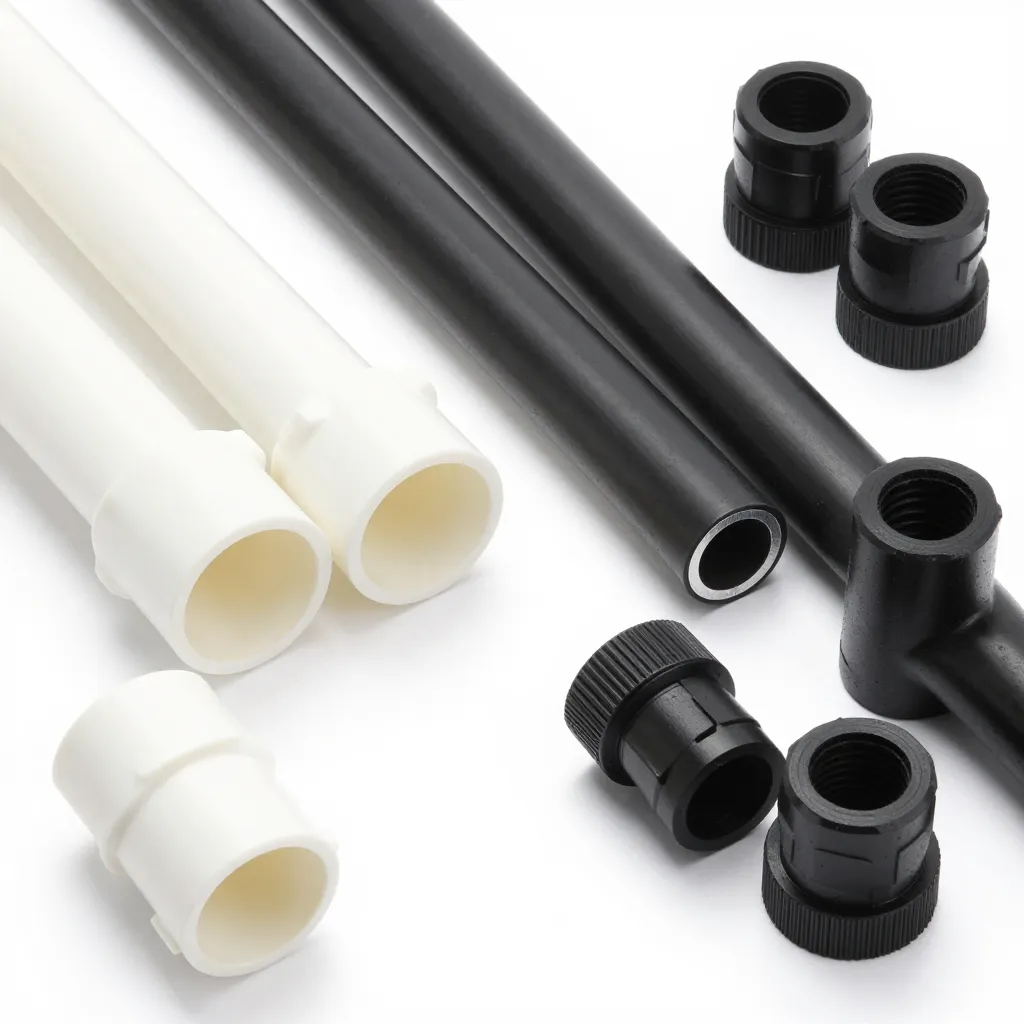
Agricultural pipeline infrastructure requires materials capable of withstanding internal hydrostatic pressures, cyclic pressure surges (water hammer), dynamic soil loads, and chemical exposure from fertilizers and soil minerals. Unplasticized Polyvinyl Chloride (uPVC) and High-Density Polyethylene (HDPE) represent two distinct polymer engineering philosophies:
- Rigid uPVC (Polyvinyl Chloride): Amorphous thermoplastic with a high tensile modulus (\(E \approx 2,800 - 3,200\text{ MPa}\)). High mechanical stiffness allows uPVC to withstand deep earth burial without ovalizing under overburden loads. However, uPVC has low fracture toughness; under cold ambient temperatures, it becomes brittle and vulnerable to crack propagation from point-load rocks.
- High-Density Polyethylene (HDPE, PE100 Resin): Semi-crystalline thermoplastic with a lower tensile modulus (\(E \approx 800 - 1,100\text{ MPa}\)) and exceptional ductile elasticity. HDPE can bend around field contours with a minimum bending radius of 20 to 25 times outer diameter, eliminating the need for 45° and 90° directional elbow fittings on curving farm boundaries.
Hydraulic Friction Loss and the Hazen-Williams C-Factor
Both PVC and HDPE feature mirror-smooth internal bores that resist mineral scale incrustation, slime buildup, and biological fouling. In hydraulic engineering calculations, both materials share an identical Hazen-Williams roughness coefficient:
$$C = 150 \quad (\text{Design Standard for Plastic Pipe})$$
However, true internal diameter (ID) differs significantly between the two materials for an identical nominal outside diameter (OD). Because HDPE requires a thicker wall to achieve the same pressure rating (lower tensile strength than PVC), its internal flow area is slightly smaller. For example, a 110mm (4-inch) PN10 uPVC pipe has an internal diameter of 104.6 mm, whereas a 110mm PN10 PE100 pipe has an internal diameter of 96.8 mm. At a flow rate of 50 m³/h, friction loss through the HDPE pipe is approximately 38% higher than through the PVC pipe due to velocity increase (\(h_f \propto D^{-4.87}\)). Hydraulic designers must compensate by upsizing HDPE pipe by one nominal increment when pumping long distances.
Comprehensive Material Performance Comparison Table
The following engineering comparison matrix evaluates uPVC and HDPE across primary commercial criteria:
| Performance Dimension |
Rigid uPVC (Bell & Spigot / Solvent Weld) |
Polyethylene (HDPE PE100 / LDPE) |
Agronomic & Engineering Verdict |
| Nominal Pressure Classes |
PN6, PN10, PN16 (6 to 16 bar / 87 to 232 psi) |
PN4, PN6, PN10, PN16, PN25 |
Both support commercial farm working pressures. |
| Joining Technology |
Rubber gasket push-fit (Z-joint) or solvent cement |
Heat butt fusion, electrofusion, or compression |
HDPE butt fusion creates a continuous, leak-free monolithic pipe with zero thrust blocks required. |
| Freeze Tolerance |
Very Poor. Trapped freezing water bursts pipe; brittle below 0°C. |
Excellent. Ductile wall expands to absorb ice volume without rupture. |
HDPE is mandatory in freezing climates and shallow-buried lines. |
| Ground Movement & Shifting |
Rigid joints can pull apart; vulnerable to shear cracking. |
High flexural ductility absorbs expansive clay and seismic movement. |
HDPE handles settling, expansive clay, and trench subsidence without failure. |
| UV Radiation Resistance |
Requires UV stabilizers; exposed surface PVC becomes brittle and chalks. |
Carbon black additive (2%–2.5%) provides 20+ years of full solar resistance. |
HDPE is standard for surface runs; PVC must be buried underground. |
| Installation Labor & Speed |
Fast bell-and-spigot push-fit in straight trenches. |
Requires skilled butt-fusion technician and generator, or coil unrolling. |
PVC is faster for straight agricultural tracks; HDPE is superior for rough terrain. |
Field Jointing Protocols: Butt Fusion vs. Gasketed Bell & Spigot
Pipeline joints represent 90% of all historical agricultural mainline failures. The joining methods dictate installation labor and maintenance longevity:
1. PVC Gasketed Push-Fit Joints
Most commercial PVC mainlines (DN80 to DN300) utilize integral bell ends fitted with elastomeric rubber lip gaskets. Pipe lengths are pushed together manually using a lever bar. While assembly is extremely rapid in flat terrain, gasketed joints cannot resist axial tension forces. Poured concrete thrust blocks are mandatory at all tees, elbows, reducers, and dead ends to prevent hydraulic surge pressure from blowing pipe bells apart.
2. HDPE Heat Butt Fusion
HDPE pipe ends are planed square, heated to 200°C–220°C using an electric heating plate, and fused together under hydraulic clamping pressure. As the polymer melts coalesce, the joint achieves 100% of the parent pipe's tensile strength. A butt-fused HDPE pipeline is completely end-load restrained: it requires zero concrete thrust blocks, can be directional-drilled under roads or waterways, and is immune to root penetration.
Application Guidelines: Sizing the Ideal Pipe for Farm Infrastructure
To optimize capital expenditure and operational longevity, commercial irrigation systems typically deploy a hybrid architecture:
- Deep Buried Primary Mainlines: Deploy gasketed uPVC pipes along straight farm boundaries where trenches are deep (below frost depth) and soil is stable. Low friction loss and fast installation reduce upfront capital cost.
- Surface Submains and Rocky Terrain: Deploy carbon-black stabilized HDPE (IrriNex DRP-CYL or solid PE pipe) connected via IrriNex VAL-BV-LG compression valves. Flexible PE absorbs solar thermal expansion and accommodates rolling hillside contours without fracturing.
Surge Pressure Resistance and Water Hammer Dynamics
Water hammer occurs when moving water columns experience sudden deceleration from rapid valve closure or pump trip. The Joukowsky equation governs peak surge pressure (\(\Delta P_{\text{surge}}\)):
$$\Delta P_{\text{surge}} = \rho \cdot a \cdot \Delta v$$
Where \(\rho\) is fluid density, \(\Delta v\) is change in flow velocity, and \(a\) is acoustic wave celerity. Wave speed \(a\) depends heavily on the elastic modulus of the pipe material:
- uPVC Wave Speed: \(a \approx 350 - 450\text{ m/s}\). A sudden valve closure generates an instantaneous pressure spike of roughly 3.5 to 4.5 bar per 1 m/s velocity change.
- HDPE Wave Speed: \(a \approx 200 - 280\text{ m/s}\). Because PE is substantially more ductile and flexible, the pipe wall expands elastically to absorb the pressure wave, cutting water hammer shock in half.
Furthermore, HDPE PE100 has a dynamic fatigue allowance that permits recurring surge pressures up to 1.5 times nominal working pressure without derating pipeline lifespan, whereas repeated hydraulic shocks in PVC pipelines cause cumulative micro-fractures around solvent joints that eventually trigger catastrophic burst failures.
Chemical Compatibility with Agricultural Fertigation and Acid Injection
Commercial micro-irrigation lines convey corrosive fertilizer salts, concentrated acids, and chlorine sanitizers. Evaluating chemical resistance across pipeline materials is vital:
- Fertilizer Solutions (NPK, Urea, Ammonium Sulfate): Both uPVC and HDPE provide 100% chemical immunity to standard agricultural fertilizer solutions, exhibiting zero corrosion or wall thinning over decades of continuous exposure.
- Sulfuric and Hydrochloric Acids (pH 2.0 to 4.0): Both polymers resist dilute and technical-grade acids used for line descaling and pH neutralization. However, solvent-cemented PVC joints can degrade over time if low-grade solvent cements containing unreacted plasticizers are exposed to aggressive aromatic hydrocarbons.
- Chlorine and Oxidizing Sanitizers: HDPE displays superior chemical resistance to continuous chlorination (10 to 50 ppm free available chlorine) and chlorine dioxide. High-concentration ozone solutions, however, can oxidize PE over extended periods, making PVDF or CPVC preferable for concentrated oxidant injection headers.
International Pressure Standards: ISO 4427 vs ASTM D2241 / ASTM D3035
Procuring pipe across global suppliers requires translating standard dimension ratios (SDR) and nominal pressure (PN) ratings:
- ISO 4427 (Metric HDPE Standard): Sized strictly by outside diameter (OD, mm) and Standard Dimension Ratio ($SDR = OD / t$). For PE100 resin:
- SDR 17 corresponds to PN10 (10 bar / 145 psi rated working pressure).
- SDR 11 corresponds to PN16 (16 bar / 232 psi rated working pressure).
- SDR 9 corresponds to PN20 (20 bar / 290 psi rated working pressure).
- ASTM D2241 (North American PVC Standard): Sized by Iron Pipe Size (IPS) or Ductile Iron Pipe Size (DIPS) outside diameters. Common SDR ratings include SDR 21 (200 psi / 13.8 bar), SDR 26 (160 psi / 11.0 bar), and SDR 32.5 (125 psi / 8.6 bar).
- Schedule 40 vs Schedule 80 PVC: Schedule pipe maintains constant outside diameter and varying wall thickness regardless of pipe size, meaning pressure ratings drop significantly as nominal diameter increases. For commercial farm mainlines above 3 inches, SDR-rated pipe is preferred over Schedule 40 because it maintains a consistent hydrostatic pressure rating across all sizes.
Trenching, Bedding, and Backfill Engineering Specifications
Both piping materials demand proper civil trenching standards to prevent point loading from rocks and uneven soil subsidence:
- Trench Bedding: Excavate trenches to a minimum depth of 600 mm for submains and 900–1200 mm for primary mainlines (below regional frost penetration lines). Provide a 100 mm bed of clean, compacted sand or screened native soil (rock particles < 10 mm) before laying pipe.
- Thermal Expansion Snaking: When installing continuous HDPE pipe in hot weather, snake the pipe loosely in the trench rather than pulling it tight. Polyethylene exhibits a high thermal expansion coefficient (\(\alpha \approx 0.15 - 0.20\text{ mm/m/}^{\circ}\text{C}\)). Snaking provides slack so that when nighttime temperatures cool the pipeline, tensile contraction forces do not pull the pipe loose from connection fittings.
- Initial Backfilling and Shading: Place 150 mm of fine screened backfill over the crown of the pipe and hand-tamp the haunches before mechanical backfilling. For PVC, perform solvent cementing in the cool morning hours and allow minimum 24-hour cure time before pressure testing.
Solvent Cement Curing Schedule and Temperature Derating
When installing rigid uPVC pipelines with solvent weld joints, chemical curing time is strictly temperature-dependent. Pressure testing a pipeline before solvent joints have fully fused causes joint blowouts:
| Ambient Temperature Range |
Pipe Sizes DN15 to DN40 |
Pipe Sizes DN50 to DN100 |
Pipe Sizes DN125 to DN200 |
Minimum Set Time Before Handling |
| 15°C to 40°C (60°F to 100°F) |
30 minutes |
2 hours |
6 hours |
15 minutes |
| 5°C to 15°C (40°F to 60°F) |
2 hours |
8 hours |
24 hours |
30 minutes |
| -10°C to 5°C (15°F to 40°F) |
8 hours |
24 hours |
48 hours |
1 hour (special cold-weather primer required) |
Never apply hydrostatic test pressures exceeding 1.0 bar until the full cure schedule has elapsed. In contrast, HDPE butt-fused joints reach 100% mechanical strength as soon as the fused polymer bead cools to ambient temperature (typically 10 to 20 minutes), allowing immediate pipeline pressurization and backfilling.
Frequently Asked Questions on Pvc Vs Pe Pipe For Agricultural Irrigation
What is the primary mechanical advantage of Polyethylene (HDPE) pipe over rigid PVC in freezing climates?
HDPE is ductile and flexible (elongation at break $> 350\%$); it can expand elastically to accommodate freezing water expansion without bursting. Rigid PVC is brittle and fractures easily when ice forms inside.
How do Hazen-Williams roughness coefficients ($C$) compare between PVC and PE pipes?
Both new PVC and smooth-wall HDPE pipes have an identical Hazen-Williams coefficient of $C = 150$, resulting in virtually identical pipe wall friction loss under clean water flow.
Why is rigid PVC preferred over PE for deep, complex valve manifold manifolds?
PVC maintains rigid geometry and tight dimensional stability without sagging or coiling, allowing compact valve manifolds with solvent-welded fittings in tight valve boxes where flexible PE pipe would distort under ground settlement.
Can standard white or purple PVC pipe be left permanently exposed on the soil surface?
No. Standard PVC contains minimal UV stabilizers; exposure to solar UV radiation degrades plasticizers, making the pipe chalky, yellow, and dangerously brittle within 2 to 3 years. Black carbon-stabilized PE pipe is engineered for 15+ years of direct surface sun exposure.