Orchard Wetting Patterns: Root-Zone Percentage and Soil Dynamics
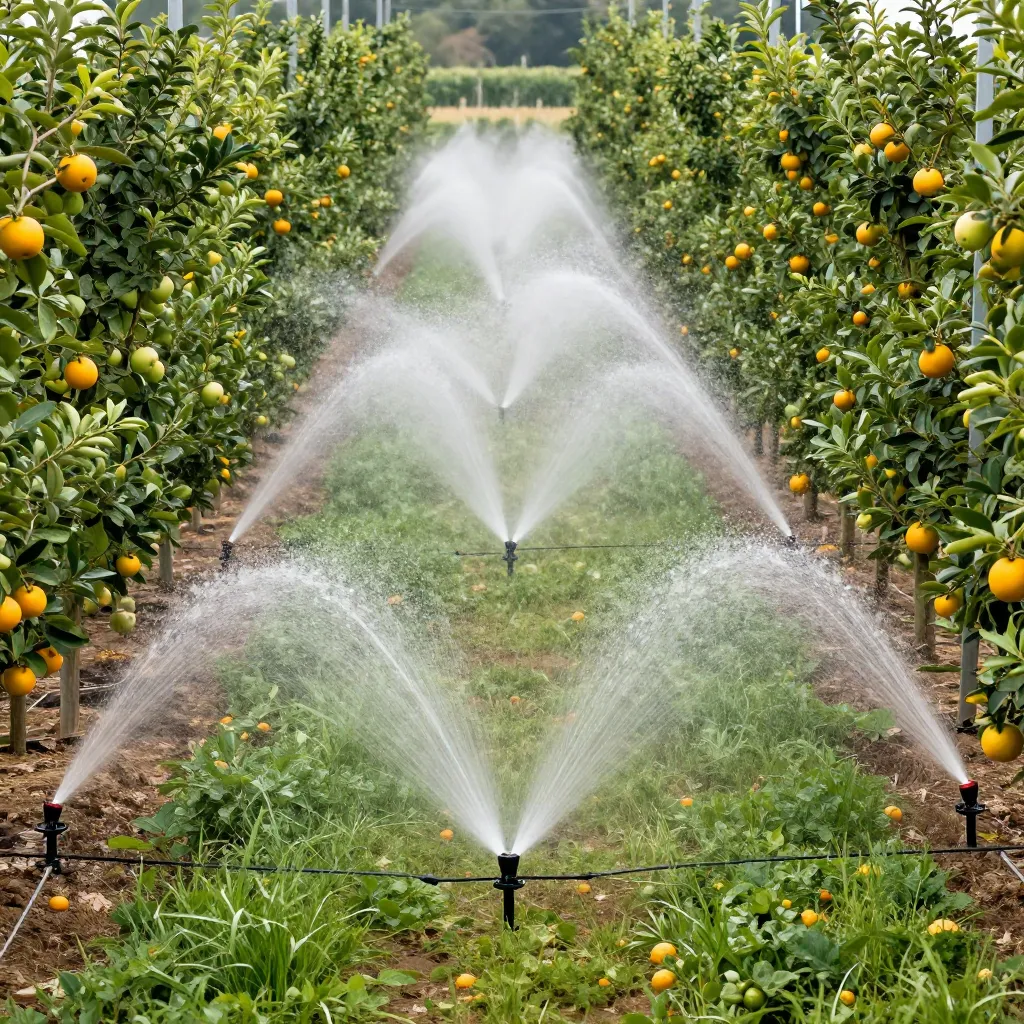
Unlike broadcast overhead impact sprinklers that wet the entire orchard floor, or surface drip emitters that concentrate moisture in narrow linear bands, micro-sprinklers provide localized under-canopy wetting patterns tailored to tree root architecture. In mature fruit and nut orchards (almonds, citrus, apples, avocados), root systems extend across 40% to 70% of the total inter-row soil area.
In coarse sandy soils with low lateral capillary action (capillary spread < 0.3 m), standard drip lines create narrow vertical moisture cylinders, leaving outer root zones desiccated. Micro-sprinklers, such as the IrriNex MSP-241T rotary micro sprinkler, throw water across diameters of 3.0 to 7.0 meters (10 to 23 feet), establishing broad, uniform wetted root zones that optimize nutrient absorption, buffer high-temperature summer stress, and accommodate lateral root growth.
Single-Line vs. Double-Line Lateral Architectures
Orchard engineers must evaluate tree row spacing, soil infiltration capacity, and capital expenditure when selecting lateral pipeline layouts:
| Design Layout |
Tree Spacing Envelope |
Sprinkler Placement |
Wetted Canopy Coverage |
Capital Cost Factor |
Best Horticultural Fit |
| Single-Line Center |
Row: 4.5–6.0 m; Tree: 2.5–4.0 m |
Midway between trees along the tree row |
40%–55% of floor area |
Baseline (1.0x) |
High-density stone fruit, citrus, young orchards |
| Single-Line Offset |
Row: 6.0–7.5 m; Tree: 4.0–6.0 m |
Offset 0.5–1.0 m from trunk line |
50%–65% of floor area |
1.1x |
Mature almonds, walnuts, wide-canopy avocados |
| Double-Line Parallel |
Row: 7.0–9.0 m; Tree: 5.0–7.0 m |
Two lateral pipes spaced 1.5–2.5 m apart on either side of tree row |
70%–85% of floor area |
1.7x–2.0x |
Pecan orchards, mature pistachio groves, saline soil leaching |
Sprinkler Throw Radius and Precipitation Rate Sizing
The precipitation rate (\(P_r\)) of an orchard micro-sprinkler block must strictly remain below the soil's saturated intake rate (\(I_s\)) to eliminate runoff and puddle formation:
$$P_r (\text{mm/h}) = \frac{q_{\text{sprinkler}} (\text{L/h})}{S_r (\text{m}) \times S_t (\text{m})}$$
Where \(S_r\) is lateral row spacing and \(S_t\) is sprinkler spacing along the lateral. For an almond block with sprinklers discharging 50 L/h spaced at 4.0m along rows spaced 6.0m apart:
$$P_r = \frac{50}{4.0 \times 6.0} = \frac{50}{24} = 2.08\text{ mm/h} \quad (0.082\text{ in/h})$$
Because the wetted pattern covers approximately 50% of the total ground area, the local precipitation rate within the wetted circle is roughly 4.16 mm/h, well within the infiltration capacity of sandy loam soils (15 to 25 mm/h).
Defeating Trunk Wetting and Fungal Collar Rot
Directly spraying tree trunks with irrigation water is a catastrophic cultural error. Continuous wetting of bark promotes trunk cankers, crown rot, and fungal root infections (Phytophthora cactorum). Modern orchard micro-sprinklers utilize two proven engineering mechanisms to protect tree trunks:
- Targeted Trunk Deflectors (Stream Splitters): Small snap-on deflectors clip onto the sprinkler nozzle, casting a 20° to 30° dry shadow wedge directly toward the tree trunk while wetting the surrounding root zone.
- Mid-Point Tree Placement: Position sprinklers exactly equidistant between adjacent tree trunks along the row. Selecting a swivel spinner with a throw radius equal to half the tree spacing (e.g., 2.5m throw for 5.0m tree spacing) allows wetting pattern overlap without water hitting the trunk bark.
Frost Protection Layout and Hydraulic Requirements
In deciduous fruit and nut orchards, micro-sprinklers serve double duty as under-canopy frost protection systems. As water freezes on the orchard floor and lower trunk, it releases latent heat of fusion (334 Joules per gram / 80 calories per gram), raising the ambient temperature within the tree canopy by 1.5°C to 3.0°C (3°F to 5.5°F).
For effective frost protection, micro-sprinklers must provide higher precipitation rates (2.5 to 3.5 mm/h across the block), complete 100% ground coverage overlap, and operate continuously without interruption until wet-bulb temperatures rise safely above 0°C (32°F). Upstream pressure regulation using IrriNex IRX-SPR pressure reducing valves ensures uniform pressure across all elevations during freezing nighttime runs.
Christiansen Uniformity Coefficient (\(CU\)) and Overlap Geometry
Achieving high distribution uniformity in micro-sprinkler irrigation prevents localized under-watering and fertilizer leaching. In field evaluations, distribution uniformity is quantified using the Christiansen Uniformity Coefficient (\(CU\)):
$$CU = 100 \times \left( 1.0 - \frac{\sum |x_i - \bar{x}|}{n \cdot \bar{x}} \right)$$
Where \(x_i\) is catch-can catch depth, \(\bar{x}\) is mean depth, and \(n\) is the number of collector cans. For commercial orchard production, \(CU\) must exceed 85%, and Low-Quarter Distribution Uniformity (\(DU_{\text{lq}}\)) must exceed 80%. When designing micro-sprinkler spacing, hydraulic engineers adhere to three geometric rules:
- Head-to-Head Overlap: When full under-canopy coverage is required (such as in frost protection or cover-crop management), spacing along the row should equal 100% of the sprinkler wetted radius (\(S = 1.0 \cdot R\)), allowing adjacent spray circles to overlap to the head of the neighboring sprinkler.
- Strip Wetting / Intermediate Overlap: For mature tree rows where inter-row alleys remain dry for harvesting machinery, sprinklers are spaced at 1.2 to 1.4 times throw radius along the row, creating a continuous scalloped wetting band 3.0 to 4.5 meters wide centered on the root zone.
- Pressure Compensation Selection: In undulating topography, non-compensating micro-sprinklers experience severe discharge variations. Installing pressure-compensating models with silicone diaphragms maintains uniform discharge (±5% flow deviation) across inlet pressures ranging from 1.5 to 4.0 bar (22 to 58 psi).
Submain Hydraulic Balancing and Lateral Run Limits
Because micro-sprinklers discharge substantially higher flow rates per unit length than drip tape (e.g., 35–70 L/h per tree versus 2–4 L/h per dripper), lateral tubing friction loss accumulates rapidly. To prevent tail-end pressure drops that collapse the wetted radius:
- Pipe Sizing Protocol: For lateral runs exceeding 100 meters, use 25mm or 32mm OD polyethylene pipe (PE100, PN6 or PN10) rather than standard 16mm or 20mm tubing. Maximum lateral water velocity should not exceed 1.5 m/s to prevent excessive friction head loss and hydraulic surge.
- Submain Manifold Zoning: Lay out submain manifolds with central feeding rather than end feeding, cutting lateral run lengths and friction loss in half. Control each submain zone with an automated diaphragm control valve (IrriNex IRX-OOCV) paired with a manual throttling limit stop.
- Riser Assemblies and Mechanical Stability: Mount micro-sprinklers on rigid plastic or fiberglass stakes driven firmly into the soil at least 25 cm deep. Loose or tilted risers distort spray trajectory angles, casting water into lower tree foliage or reducing throw radius by up to 40%. Connect each sprinkler to the lateral pipe using heavy-duty 4x7mm or 5x8mm PVC micro-tubing secured with barbed fittings.
Step-by-Step Worked Hydraulic Sizing: 10-Hectare Citrus Block
The following engineering design sizes a commercial micro-sprinkler lateral and manifold system for a mature Valencia orange grove:
- Row Spacing (\(S_r\)): 6.0 meters (19.7 ft).
- Tree Spacing (\(S_t\)): 3.5 meters (11.5 ft).
- Lateral Run Length: 140 meters (40 sprinklers per lateral, one per tree).
- Sprinkler Specification: IrriNex MSP-241T with 1.3 mm blue nozzle; nominal discharge \(q = 40.0\text{ L/h}\) at \(P_{\text{nom}} = 2.0\text{ bar}\).
- Lateral Pipe Material: Polyethylene PE100, 25mm OD (Inside Diameter \(d = 21.2\text{ mm}\)), Hazen-Williams \(C = 150\).
Step 1: Calculate Total Lateral Flow Rate
$$Q_{\text{lat}} = N_{\text{sprinklers}} \times q = 40 \times 40.0\text{ L/h} = 1,600\text{ L/h} = 0.444\text{ L/s} \quad (7.04\text{ GPM})$$
Step 2: Calculate Plain Pipe Friction Loss (Hazen-Williams)
For a continuous non-discharging pipe conveying 0.444 L/s across 140 meters:
$$J = 1.22 \times 10^{10} \times \left( \frac{0.444}{150} \right)^{1.852} \times (21.2)^{-4.87} = 0.0275\text{ m/m}$$
$$H_{f,\text{plain}} = 0.0275 \times 140\text{ m} = 3.85\text{ meters of head}$$
Step 3: Apply Christiansen Multi-Outlet Reduction Factor (F)
For \(N = 40\) equally spaced outlets, Christiansen's reduction factor \(F\) is approximately 0.362:
$$H_{f,\text{lateral}} = F \times H_{f,\text{plain}} = 0.362 \times 3.85\text{ m} = 1.39\text{ meters of head} \quad (0.136\text{ bar} = 1.98\text{ psi})$$
Step 4: Check Pressure Uniformity Criterion
Allowable lateral pressure loss is 10% of nominal pressure: \(\Delta P_{\text{allow}} = 0.10 \times 2.0\text{ bar} = 0.20\text{ bar}\). Because \(0.136\text{ bar} < 0.20\text{ bar}\), the 25mm lateral pipe is hydraulically compliant, guaranteeing that flow variation along the 140-meter row will remain below 4%.
Nozzle Orifice Wear Monitoring and Acid Bath Descaling
Over multiple seasons, micro-sprinklers undergo two primary forms of physical degradation:
- Abrasive Orifice Enlargement: Water containing fine sand grains causes gradual erosion of plastic nozzle orifices. An increase of just 0.1 mm in nozzle diameter increases flow rate by 15% to 20%, leading to block over-discharge and localized pump cavitation. Inspect nozzle diameters annually using precision optical pin gauges.
- Calcium Carbonate Incrustation: In hard water areas, evaporative drying on nozzle spinner plates leaves mineral deposits that unbalance the rotor, causing the spinner to stall and emit a solid static stream instead of a rotary spray. Soak stalled spinners in an 8% sulfamic or phosphoric acid bath for 30 minutes to dissolve mineral scale without etching polymer surfaces.
Comprehensive Orchard Crop Micro-Sprinkler Spacing Matrix
| Crop Type |
Tree Spacing (Row × Tree) |
Recommended Micro-Sprinkler Model |
Nozzle Size & Flow Rate |
Throw Diameter |
Spacing on Lateral |
Average Precipitation Rate |
| Almonds |
6.5 m × 4.5 m |
IrriNex MSP-241T Rotary |
1.4 mm / 45 L/h @ 2.0 bar |
5.5 m |
4.5 m (one per tree) |
1.54 mm/h |
| Citrus (Oranges) |
5.5 m × 3.0 m |
IrriNex MSP-241T Rotary |
1.2 mm / 35 L/h @ 2.0 bar |
4.5 m |
3.0 m (one per tree) |
2.12 mm/h |
| Avocados |
7.0 m × 5.0 m |
IrriNex Double-Line Rotary |
1.6 mm / 55 L/h @ 2.5 bar |
6.5 m |
5.0 m (two per tree) |
3.14 mm/h |
| Apples (Trellised) |
3.8 m × 1.2 m |
IrriNex Micro-Jet Static |
1.0 mm / 28 L/h @ 1.8 bar |
3.0 m |
2.4 m (one per 2 trees) |
3.07 mm/h |
| Pistachios |
6.0 m × 5.0 m |
IrriNex Swivel Micro-Sprinkler |
1.5 mm / 50 L/h @ 2.0 bar |
6.0 m |
5.0 m (one per tree) |
1.67 mm/h |
Frequently Asked Questions on Micro Sprinkler Spacing Guide For Orchards
What percentage of the orchard floor / tree root zone should micro-sprinklers wet?
In arid commercial orchards (almonds, citrus, avocados), micro-sprinklers should wet 40% to 65% of the total orchard floor area directly beneath the canopy dripline to encourage expansive root architecture and buffer against summer heat spikes.
Where should rotating micro-sprinklers be positioned relative to tree trunks?
Place sprinklers midway between trees along the row, or offset 60 to 90 cm from the trunk. Never spray directly against tree trunks, as continuous trunk wetting promotes fungal crown rot (Phytophthora).
What is the typical operating pressure and throw radius of commercial orchard micro-sprinklers (such as IrriNex MSP-241T)?
Nominal operating pressure is 1.5 to 2.5 bar (150–250 kPa / 22–36 PSI), delivering throw radii between 2.0 to 4.5 meters (wetted diameters of 4 to 9 meters) with flow rates from 35 to 120 L/h.
Can under-canopy micro-sprinklers be used for orchard spring frost protection?
Yes. Applying water continuously at 2.5 to 3.5 mm/h during freezing temperatures releases latent heat of fusion (334 Joules per gram of freezing water), keeping the ground and lower canopy 1°C to 2°C above ambient.