Irrigation Water Sources: Quantity, Quality, and Legal Access
Abstract: Irrigation water sources are surface water, groundwater, stored water, or managed combinations that supply crops through an authorized withdrawal and distribution system. Evaluating them matters because a source must satisfy three tests simultaneously: enough quantity at peak demand, quality compatible with soil, crop, food use, and emitters, and a lawful right that does not unacceptably harm other users or the environment. This guide compares surface diversions, groundwater wells, and combined or stored supplies, then follows five steps from demand calculation and yield testing to laboratory analysis, legal review, hydraulic design, and long-term monitoring. United Nations FAO guidance evaluates salinity, infiltration, specific-ion, and toxicity risks in field context, while U.S. Department of Agriculture (USDA) research shows that legal institutions and storage and conveyance investment influence regional source use. A nearby water body or productive test bore is therefore only a candidate source until quantity, quality, and access are documented.
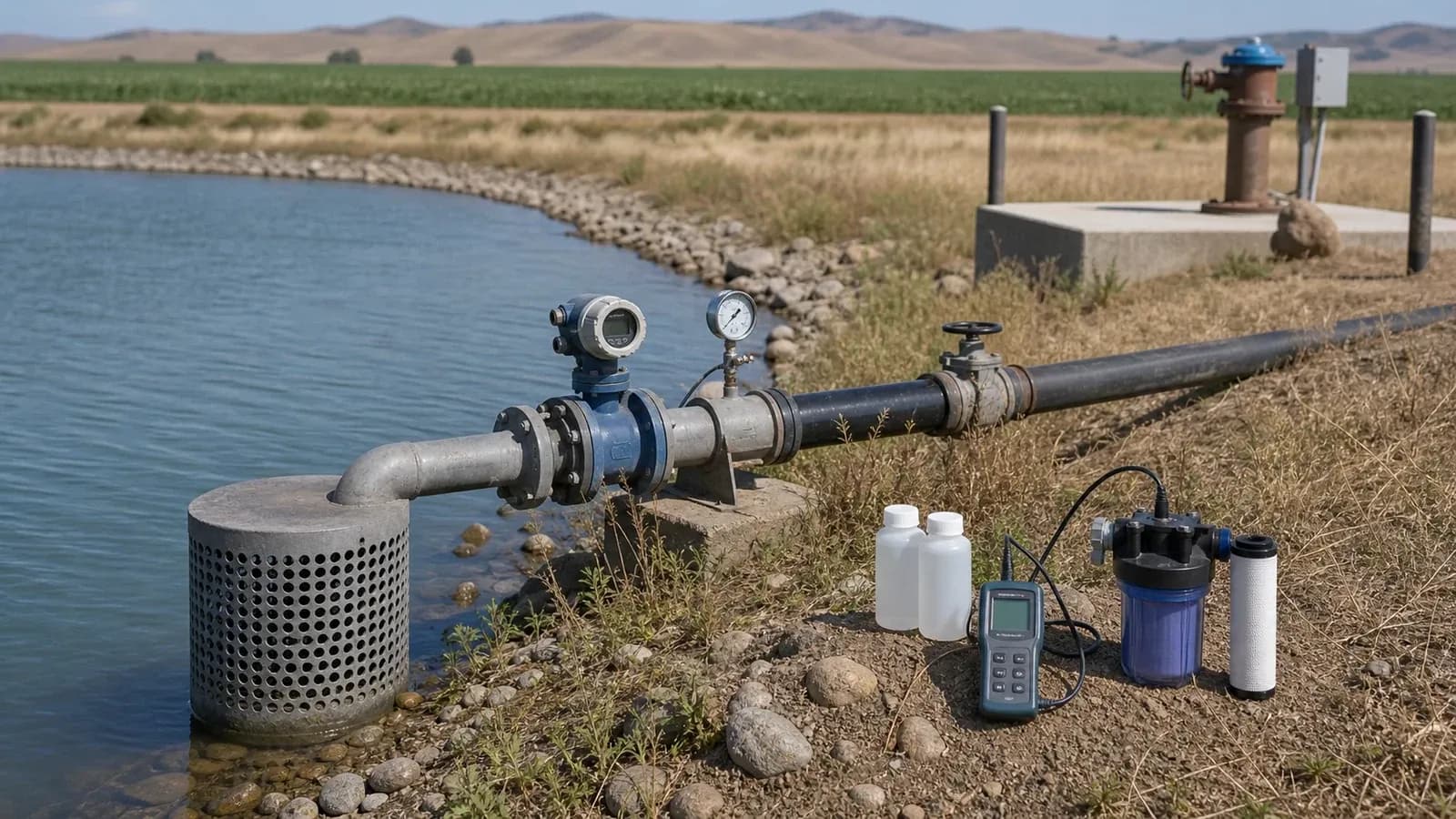
What are the three tests for an irrigation water source?
IrriNex (a professional agricultural irrigation systems and component supplier) defines available water as the lawful, treatable volume remaining at the field inlet during the peak design period. Quantity is dependable flow and stored volume, quality is the physical, chemical, and biological condition of that water, and legal access is the documented authority to withdraw and convey it under stated limits.
The U.S. Department of Agriculture Economic Research Service (USDA’s economic research agency) concludes that resource availability alone does not determine source choice: legal institutions and investment in storage and conveyance also shape regional use. That relationship explains why engineering should begin only after ownership, permits, priority, reporting, and drought restrictions are understood.
Compare three irrigation source configurations
| Configuration | Advantages | Limitations | Best suited for |
|---|---|---|---|
| River, lake, canal, ditch, or pond diversion | Can supply high flow at low lift; a pond adds storage | Dry-season decline, sediment, organisms, pollution, and downstream obligations | Best suited for permitted sites with measured low-flow yield and protected intake |
| Deep, shallow, or horizontal groundwater well | Compact source and usually steadier quality and temperature | Uncertain drilling yield, drawdown, sand, minerals, energy, and well interference | Best suited for a tested aquifer with licensed construction and monitoring |
| Combined source with engineered storage | Balances weak continuous yield against short high zone flow and adds resilience | Water is handled twice; controls, evaporation, treatment, and approvals increase | Best suited for high-value farms with variable sources or narrow irrigation windows |
Evaluate irrigation water sources in five steps
1. Calculate peak quantity and operating capacity
Convert peak crop water use into daily volume, add application and conveyance losses, then divide by realistic operating hours and days between irrigations. Michigan State University Extension’s Michigan–Indiana example relates 0.25–0.30 inches/day to about 5–7 gpm/acre under continuous pumping, illustrating why a shorter operating window requires greater flow.
2. Test sustainable source yield and conflicts
Measure a surface source during a dry peak-use period or conduct a sustained well test that records discharge, drawdown, and recovery, not only drillers’ estimated capacity. Map neighbouring wells, upstream diversions, downstream users, environmental flow, reservoir leakage, and drought trends so the design does not consume a shared reserve.
3. Analyze quality for crop, soil, and equipment
Use representative samples and a qualified laboratory for sediment, salinity, sodium hazard, pH, bicarbonate, chloride, boron, nutrients, iron, manganese, microorganisms, and pollutants relevant to the site. Food and Agriculture Organization of the United Nations guidance (FAO’s agricultural water-quality reference) warns against interpreting laboratory limits without crop, soil, climate, drainage, and management conditions; translate the result into filtration and treatment.

4. Document lawful access before construction
Verify land and water ownership, diversion or groundwater rights, well-construction rules, withdrawal registration, metering, environmental review, health requirements, and permission to cross other property. Ask the regulator how priority, transfer, maximum volume, reporting, and curtailment work during shortage, and record a remedy plan for affected neighbouring wells or users.
5. Engineer distribution and long-term monitoring
Size the pump, storage, irrigation pipe, surge protection, treatment, control valves, and field zones from the verified source envelope. Install meters and sampling ports, then trend withdrawal, energy, water level, recovery, pressure, filter differential, water quality, and crop response against permit and design triggers.
Conclusion: document all three tests before investment
A source is viable only where peak quantity, manageable quality, and lawful access overlap throughout the project life; strength in one dimension cannot cancel failure in another. Action 1: create a one-page source dossier with yield-test curves, laboratory results, and permit limits. Action 2: submit that dossier and the field elevation plan to the IrriNex technical team before specifying treatment and distribution equipment.