Irrigation Valve Materials: Match Seals and Bodies to Water Chemistry
Select irrigation valve materials by matching every wetted component to the actual liquid, concentration, temperature, contact pattern and mechanical duty. A body marked PVC or a seal described as EPDM or FKM is only the beginning of that check. Obtain the exact material designation and evidence covering the intended conditions, then resolve the weakest or undocumented part before approving the complete assembly.
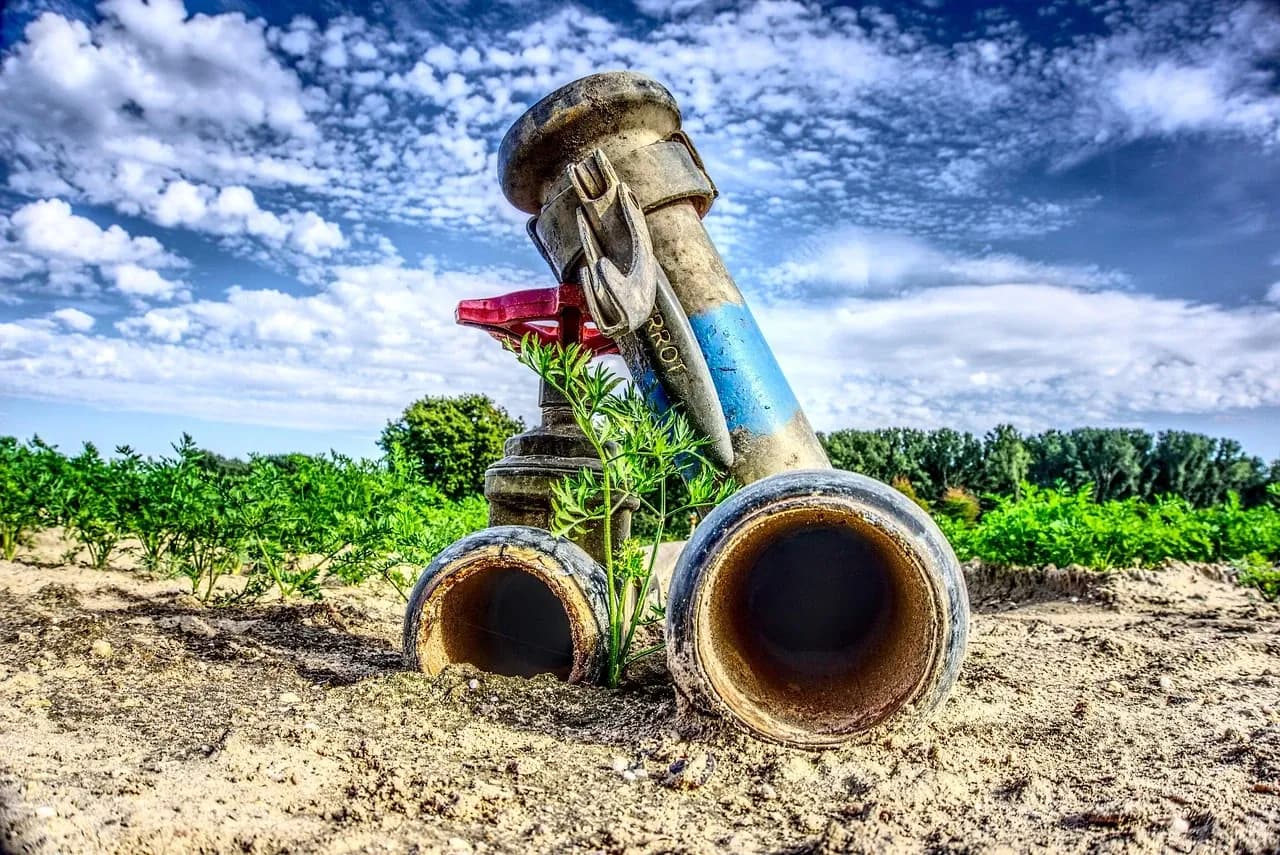
Irrigation pipework and a valve in a field. Surface appearance does not identify material grades, internal seals or chemical compatibility. Photo: distelAPPArath / Pixabay.
The useful purchasing document is a component-by-exposure record. It connects the valve drawing and replacement-part list with water analyses, chemical product information and traceable compatibility evidence. The example below shows how to find gaps in that record without inventing laboratory results or treating a general chemical-resistance chart as a product warranty.
1. Map everything the liquid can touch
Start with the selected valve model and revision, including its actuator, pilot circuit and connection accessories. Trace the liquid route in each operating state. A main passage, pilot tube, bonnet chamber and closed-valve cavity may have different contact conditions. Confirm which springs and fasteners are wetted; proximity to water on a photograph is insufficient evidence.
Use the irrigation valve function guide to identify the required assembly. This review then follows its actual parts, rather than comparing valve functions again. The categories below are prompts for an inventory, not a claim that every valve contains all of them.
| Part or interface | Identification needed | Question the evidence must answer |
|---|---|---|
| Body, cover and closure element | Exact resin compound or metal alloy, lining and coating | Does the evidence cover the supplied formulation and exposed surfaces? |
| Seats, stem seals and static O-rings | Compound identifier, hardness and relevant part number for each seal | Is the stated resistance for this compound and sealing duty? |
| Diaphragm and reinforcement | Elastomer compound, reinforcement and bonded layers where present | Are liquid exposure, flexing and layer adhesion addressed? |
| Pilot passages and small fittings | Tubes, fittings, small seals and any wetted lubricant | Does approval of the main body leave a smaller exposed part unchecked? |
| Metal stems, springs and pins | Alloy grade, finish, coating and confirmed wetted status | Are corrosion and contact between dissimilar metals relevant to this assembly? |
| Connection joints | Gasket compound, sealant or solvent-cement system and cure requirements | Does the evidence cover the finished joint as well as the adjoining bodies? |
Give each actual part its own identifier in the final record. A single row labeled “rubber” cannot represent several different seals. If a supplier protects a proprietary formulation, request a stable compound code and written confirmation tied to the supplied part and revision. You need traceability, not necessarily disclosure of the entire recipe.
2. Describe the exposure at the valve, including stopped conditions
A source-water analysis describes the sample collected at a stated place and time. It does not automatically describe liquid inside a valve downstream of injection, during treatment, or after shutdown. Collect the relevant operating records alongside the irrigation water testing guide. Filtration specifications and dissolved-chemical compatibility answer different questions.
Identify the chemical species or commercial formulation, its concentration and the basis of that concentration. Record whether a value describes the active ingredient or the supplied product, and whether it is a mass fraction, volume fraction or mass per volume. Product safety information helps identify hazards and composition, but is not a valve-material approval. pH or electrical conductivity alone does not identify every chemical that contacts a seal.
| Operating condition | Liquid information | Physical and time information |
|---|---|---|
| Ordinary irrigation | Source and seasonal analysis, dissolved constituents and relevant oxidant species | Temperature range, operating pressure and time left wet between cycles |
| Operation with an injected product | Actual formulation and mixture reaching this valve, including the basis of concentration | Mixing location, exposure duration, repetition and credible local excursions |
| Authorized cleaning or treatment contact | Exact product and any remaining or displaced liquid | Which parts are exposed, contact and rinse conditions, and trapped-liquid residence |
Include an exposure only when the operating arrangement permits it, but do not assume a closed valve isolates every cavity or pilot passage. Trace the route and isolation boundary. Similarly, a fertilizer stock tank concentration is not automatically the concentration in the main irrigation line. Conversely, a mainline dilution does not describe a valve that actually handles stock solution.
The fertigation stock-solution compatibility guide covers a separate decision about the liquids being mixed. A clear mixture does not demonstrate that it is compatible with the valve body, diaphragm or seals. This article supplies no cleaning dose, chemical mixing instruction or treatment schedule.
3. Read the conditions behind a chemical-resistance rating
The public scope and significance notes for ASTM D543-21 on plastics and chemical reagents distinguish immersion from exposure under mechanical strain. They explain that usefulness for service depends on similarity between test and operating conditions. A short exposure can screen candidates without establishing long-term suitability. These notes support the questions to ask; they do not certify a particular irrigation valve.
For each referenced result, record the tested material, reagent identity and concentration, temperature, duration, loading, specimen form, conditioning and measured property. Keep the test method and edition with the report. Look for the acceptance criterion and the actual finding, not just a letter or a green cell. A ranking based on appearance cannot silently become evidence of retained strength.
The EPA's historical groundwater materials-compatibility review explicitly distinguishes conflicting data from missing data and describes limits on transferring compiled results to field conditions. Its contaminant tables concern well construction and remediation; they are not an irrigation approval list. The transferable lesson is to preserve the conditions and uncertainty attached to a rating, rather than importing its material rankings.
Ask the supplier or qualified materials specialist to resolve contradictions. Two favorable charts may share one original reference, so they are not necessarily independent confirmation. An empty cell means that the needed evidence has not been supplied. It establishes neither compatibility nor incompatibility.
4. Check seals, diaphragms and joints as working parts
The public description of ASTM D471 for the effect of liquids on rubber covers comparative changes such as mass, volume and mechanical properties. It also cautions that accelerated immersion data need not correlate directly with actual part performance. A specimen result is useful evidence, but an installed seal must still retain its sealing function under its particular compression, movement and pressure conditions.
EPDM and FKM identify material families, not interchangeable finished compounds. Formulation, cure system, fillers and part manufacture can matter. An O-ring compound and a reinforced diaphragm bearing the same broad polymer name need separate identification. Ask whether the qualification covers the supplied compound, the complete diaphragm construction and the relevant movement or loading.
Small dimensional changes can matter at a sealing interface even when the main body remains visibly intact. Request criteria relevant to that part, such as retained sealing, mechanical integrity or acceptable dimensional change, with the evidence supporting those criteria. Do not invent a universal allowable swelling percentage, and do not assume that “no visible change” means the seal will continue to work.
For a solvent-cemented connection, identify the actual cement and primer system, joined materials and required cure conditions. Body-resin compatibility does not qualify every adhesive or sealant applied to it. Replacement grease, thread sealant or a substitute gasket also belongs in the review if it can contact the liquid or affect the joint. Follow the specified installation procedure; extra tightening is not a remedy for chemical uncertainty.
5. Work through a hypothetical evidence-gap example
Suppose a proposed valve will encounter an identified liquid formulation at up to 38 °C and an operating pressure of 5 bar. These are invented project inputs, not recommended irrigation conditions. Assume the proposed intermittent contact consists of 12 events lasting 30 minutes each. The example evaluates documentation only; it supplies no test outcomes and approves no chemical treatment.
| Item | Information hypothetically supplied | Unresolved question |
|---|---|---|
| Body | Exact compound identified; a chemical report describes unloaded immersion at 25 °C | Does suitable evidence cover 38 °C and the stressed, pressurized assembly? |
| O-ring | Only the family name EPDM | Which finished compound and part were supplied, and what evidence applies? |
| Diaphragm | A compound report describes 72 hours of continuous static immersion | Does evidence address the complete diaphragm, repeated exposure and flexing? |
| Spring | An alloy designation is listed, but the liquid path is unclear | Is the spring wetted, and if so is that exact alloy and condition covered? |
| Joint | The connecting bodies are identified; the cement and cure record are absent | Which joining system was used, and is the finished joint covered? |
The temperature difference is 38 − 25 = 13 °C. That is an evidence gap, not a usable temperature margin or a prediction of failure. The proposed contact totals 12 × 30 = 360 minutes, or 6 hours. Comparing that total with 72 hours does not establish equivalence: refreshed liquid, wet and dry periods, temperature, loading and movement can differ. A longer static test is not automatically a more severe version of the proposed service.
Every row remains unresolved for the indicated reason. Do not average them into a compatibility score or treat four documented parts as compensation for an undocumented fifth. Complete the liquid description first, then request evidence for each gap. If a component is demonstrably outside the wetted boundary, document that basis instead of assigning it an unsupported compatibility rating.
6. Keep pressure and temperature limits attached to the complete assembly
Find the pressure-temperature limits for the supplied valve configuration and liquid duty. A chemical chart at ambient temperature does not establish the pressure rating at the highest operating temperature. Likewise, a pressure rating does not demonstrate resistance to the intended chemical mixture. Review both conditions together with the applicable component and assembly evidence.
Consider the actual load cases: steady operation, closure and restart, differential pressure, cycling and external pipe loads where relevant. Do not turn a materials review into a claim of surge protection. A proposed change of seal or diaphragm can also affect friction, travel or required actuation force; confirmation must address the assembled function, not only the replacement material's chemical name.
The PVC irrigation pipe sizing guide addresses dimensional information for hydraulic calculations. A matching connection size neither identifies the valve compound nor establishes chemical compatibility. Keep fit, hydraulic capacity, materials suitability and pressure qualification as linked checks with their own evidence.
7. Close the review with traceable conditions and change control
Issue a record naming the valve model, part revisions, exact materials, permitted exposure envelope and supporting document revisions. Identify any unresolved item and who must resolve it before the proposed service is accepted. Where testing is necessary, a qualified laboratory and responsible designer should define representative specimens, conditions and acceptance criteria. An informal soak followed by a visual inspection is not a substitute for that qualification.
Keep commissioning observations separate from chemical-resistance proof. A leak-free startup can confirm a limited operating check while providing little information about longer exposure. Inspection findings may trigger investigation, but discoloration, swelling or leakage alone does not identify the chemical cause. Isolate and depressurize equipment under the applicable procedure before intrusive inspection.
Reopen the review when the water source, injected formulation, treatment procedure, temperature envelope, replacement compound or joining product changes. Retain the previous approval and the reason for the revision. The outcome is a bounded decision for a traceable assembly, with visible limits that operators and purchasing staff can maintain.
8. Questions about irrigation valve material compatibility
Is FKM always better than EPDM for irrigation chemicals?
No universal ranking follows from those family names. Compare the exact supplied compounds against the actual formulation, concentration, temperature and mechanical duty. A favorable result for one service cannot approve a different liquid or seal construction.
Does an approved body material qualify the whole valve?
No. Seats, stem seals, diaphragms, pilot components, metal parts and joints may introduce different exposed materials. Trace all actual wetted parts and obtain evidence for the complete configuration, including authorized replacements.
Can a short soak or a clear fertilizer mixture prove compatibility?
Neither establishes long-term valve performance. A clear mixture describes an observation about the liquid; a short soak describes limited specimen exposure. Both require appropriate interpretation, and neither replaces component identification and service-relevant qualification.