Irrigation Controller Programs: Separate Start Times, Stations, and Cycles
An irrigation controller start time often starts an entire program, while a station run time sets how long one valve operates. Adding a start time for every station can therefore repeat the whole watering sequence. Before changing a schedule, map programs, stations, start times and cycle settings into a timeline, using the behavior documented for the actual controller.
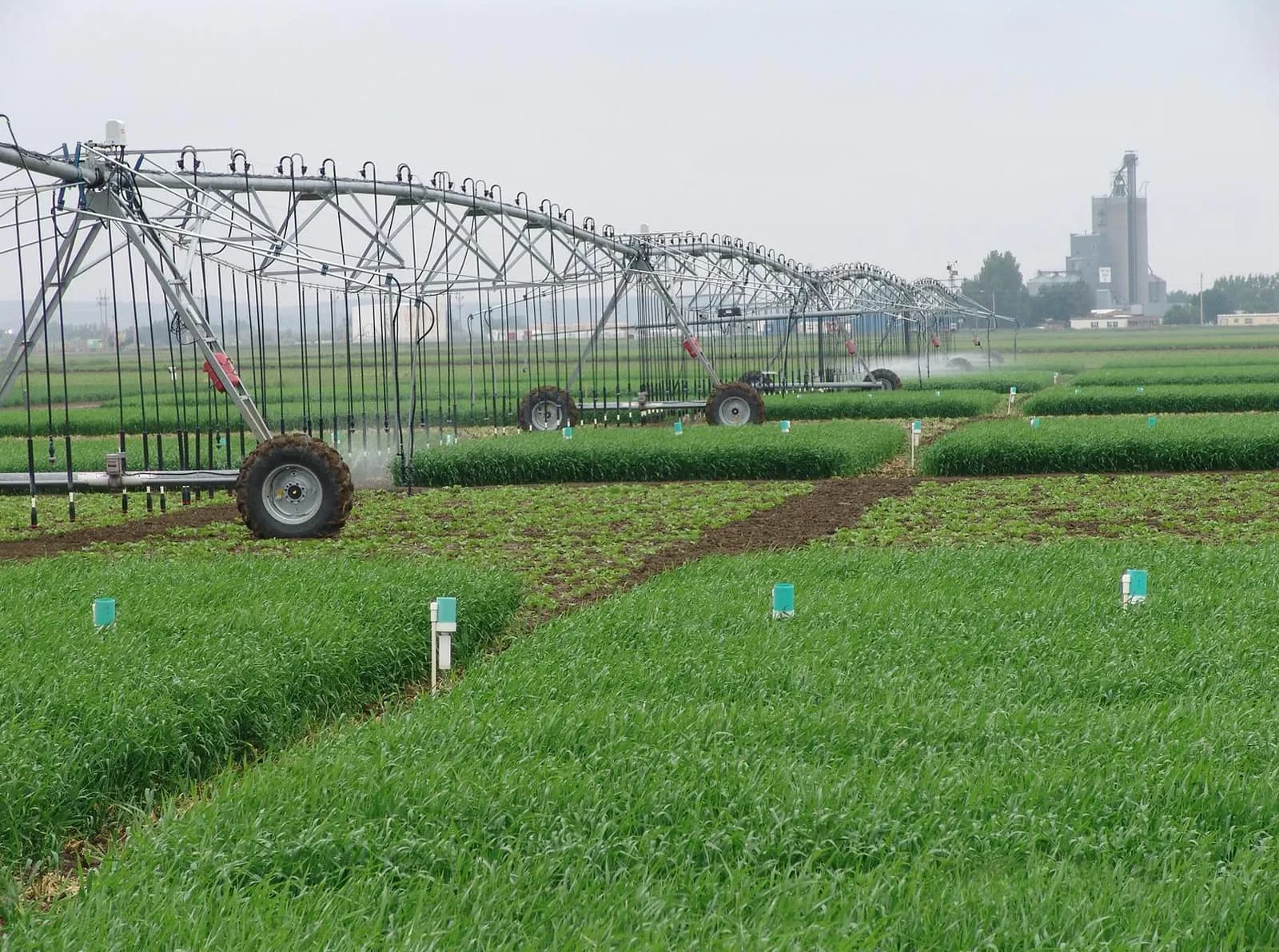
A linear irrigation system applying water to barley and sugar beet crops. The photograph shows field equipment, not the station durations or program settings in this example. Photo: James Kim, USDA Agricultural Research Service.
This guide builds an original program table for a farm installation and checks repeated starts, seasonal adjustments and soak intervals. Every time and duration in the examples is hypothetical. The examples verify controller logic; they do not establish the water requirement of a crop or the hydraulic capacity of a pump.
1. Give each scheduling term a separate job
A program is a group of scheduling settings, rather than another name for a valve. A station is an output or assigned valve function. Some platforms organize schedules by blocks, tasks or irrigation events instead of lettered programs. Translate the manufacturer's terms into a written record before assuming that one screen behaves like another.
| Term | Question it answers | What must be verified |
|---|---|---|
| Program | Which stations share this schedule? | Membership, permitted days and the sequence or concurrency rule |
| Station run time | How long does this station run within one execution? | Base duration, adjustments and any zero-duration behavior |
| Program start time | When is another program execution requested? | Whether that request repeats every assigned station |
| Cycle and soak | How is a required run divided and spaced? | Whether the feature splits a total or requires separate entries |
| Station transition delay | What gap occurs between outputs? | Whether it changes pump operation or occupies schedule time |
| Seasonal adjustment | How is the base schedule modified? | Which durations it changes, including rounding and limits |
Use the AC, DC and decoder controller guide to identify the output architecture. Then record the scheduling behavior separately. A two-wire installation can still have sequential programs, and having many station addresses does not establish that all of them may irrigate together.
Assign each physical valve a stable field identifier, such as North-1, rather than relying only on a screen number. This makes it possible to recognize the same valve when it appears in two programs or when an expansion changes the output map.
2. Write one complete program execution as a timeline
Consider an illustrative Program A with three stations operating sequentially. Their base run times are 18, 26 and 12 minutes. There is a fixed one-minute gap between consecutive stations and no gap added after the final station. These rules are explicit assumptions for the example.
The total valve-running time for one execution is 18 + 26 + 12 = 56 station-minutes. There are two transition gaps, so the elapsed execution time is 58 minutes. A start at 04:30 therefore finishes at 05:28. The distinction matters whenever another program, pump operation or labor task must fit into the same window.
| Step | Duration | First start at 04:30 | Second start at 05:45 |
|---|---|---|---|
| North-1 station | 18 minutes | 04:30–04:48 | 05:45–06:03 |
| Transition gap | 1 minute | 04:48–04:49 | 06:03–06:04 |
| North-2 station | 26 minutes | 04:49–05:15 | 06:04–06:30 |
| Transition gap | 1 minute | 05:15–05:16 | 06:30–06:31 |
| North-3 station | 12 minutes | 05:16–05:28 | 06:31–06:43 |
The second start repeats all three stations under the assumed program behavior. Daily station totals become 36, 52 and 24 minutes. That is 112 station-minutes plus four minutes of internal transition gaps across the two executions. The first start to final finish spans 133 minutes because it also includes the 17-minute gap between executions.
Keep these three quantities separate: a valve's daily run time, total station-minutes and elapsed clock time. They are different measurements and become even less interchangeable when a controller permits concurrent stations.
3. Audit every route by which a valve can start
For each field valve, list every program, start time and permitted day that can activate it. Include interval calendars, odd/even-day settings where used, temporary manual runs and sensor-triggered events. A valve may receive more water than intended even though every individual program looks reasonable.
If North-2 also belongs to Program B for a separate 10-minute run on the same day, its scheduled total becomes 62 minutes in this example: 52 from the two executions of A and 10 from B. That arithmetic assumes all runs complete and that the additional program does not replace or interrupt another event. Check the actual execution record before treating the scheduled total as delivered irrigation.
Do not remove an apparent duplicate without finding its purpose. Separate crop blocks, establishment watering or a maintenance operation may explain additional events. The correct action is to reconcile the schedule with the irrigation plan and name the responsible person, rather than preserving unexplained settings indefinitely.
The guide to irrigation zoning by crop stage and substrate explains why different groups may need separate management. Scheduling should preserve those distinctions without accidentally assigning the same physical valve to incompatible programs.
Save an export or dated screenshots before changing settings. Record the controller clock, time zone, active calendar and any automatic adjustment mode. A correct timeline based on the wrong clock can still operate outside the intended watering window.
4. Recalculate collisions after a seasonal adjustment
Suppose Program A changes to 150 percent and the controller scales only station run times, leaving each transition gap at one minute. The three runs become 27, 39 and 18 minutes. Their sum is 84 minutes, and the complete execution takes 86 minutes after adding two gaps.
The first 04:30 execution now finishes at 05:56. The existing 05:45 second start requests another execution 11 minutes before the first finishes. That is a schedule conflict under this example's single-sequence operating assumption; it is not evidence of how an unspecified controller resolves the conflict.
| Check | 100 percent | 150 percent |
|---|---|---|
| Station run times | 18 / 26 / 12 minutes | 27 / 39 / 18 minutes |
| One complete execution | 58 minutes | 86 minutes |
| Finish after a 04:30 start | 05:28 | 05:56 |
| Relationship to a 05:45 request | 17 minutes clear | 11 minutes overlap |
| Two complete executions: station-minutes | 112 | 168 |
A controller might queue, skip, interrupt or run events concurrently depending on its design and configuration. Read its documented rule and verify the resulting log. Concurrency also needs available flow, pressure and permitted electrical loading; changing a software option does not establish those capacities.
Moving the second request to 06:00 clears the first execution in this illustration, but the second then ends at 07:26. If the farm has chosen an illustrative 04:30–07:00 operating window, the revised schedule exceeds it by 26 minutes. Reconcile the required water, available window and system capacity instead of arbitrarily shortening a crop's run time to make the screen look tidy.
5. Keep cycle duration separate from total irrigation
Cycle-and-soak scheduling divides a required irrigation into shorter applications with pauses. Texas A&M AgriLife's guide to preventing runoff with cycle and soak explains the approach and the effect of repeating stations through multiple program starts. Its landscape examples describe scheduling mechanics; their run lengths are not prescriptions for an agricultural field.
For an independent one-station example, assume the required total is 36 minutes and divide it into three 12-minute cycles. Starts at 02:00, 02:50 and 03:40 produce finishes at 02:12, 03:02 and 03:52. Each soak interval is 38 minutes, measured from the end of one application to the beginning of the next. The 50-minute spacing between start times is not the soak duration.
If separate starts each repeat the full station duration, entering 36 minutes with three starts would request 108 minutes rather than the intended 36. If the controller has a native cycle-and-soak feature that divides one total automatically, extra program starts may also repeat that total. Confirm the feature's semantics before combining the two methods.
Colorado State University Extension's scheduling guidance likewise discusses dividing irrigation to limit runoff and adapting schedules to site conditions. The field decision still requires observations of infiltration, runoff and the wetted root zone. A timer's ability to insert a pause does not prove that the selected cycle suits the soil, slope, crop or emitter arrangement.
6. Compare the requested schedule with actual operation
Prepare a dated test sheet showing program, field valve, requested start, expected finish, observed start, observed finish and any interruption. Use an authorized operating period with someone able to observe the installation. Preserve the pre-change schedule and restore any temporary test settings after checking them.
Follow at least one complete sequence and inspect the boundary where a repeat or another program begins. A brief manual station test can confirm that an output responds, but it does not demonstrate the automatic calendar, repeated-start behavior or conflict handling. Repeat the timeline calculation whenever an active adjustment changes.
Compare controller records with available flow or field observations. A completed command does not by itself establish that the intended water reached the crop. Conversely, a communication outage does not necessarily mean a local schedule stopped; the guide to irrigation with unreliable internet separates local execution from remote visibility.
Record whether rain holds, flow alarms or other configured conditions prevented an event, and retain the reason. An event intentionally inhibited by a verified rule should not be logged as an unexplained missing start. Review the field consequences before retrying a missed irrigation, because the next scheduled event may already be close.
7. Hand over a program sheet that can be checked later
The final sheet should identify the controller and date, clock settings, program membership, permitted days, every start request, base run times, active adjustments, cycle rules, transition gaps and conflict behavior. Include the calculated start-to-finish timeline and the observed evidence used to confirm it.
Add a per-valve daily total for each relevant calendar case. A Monday with an extra establishment program may differ from the following day. Record who can change the schedule and which field observations trigger review, rather than allowing temporary overrides to become unexplained permanent settings.
Translate run time into an agronomic quantity only when the application rate and effective coverage are known. The drip irrigation application-rate calculation provides that separate step. This program audit establishes what the controller requests and executes; field measurements establish what the irrigation delivers.
8. Frequently asked questions
Do I need a separate start time for each irrigation station?
Not when a start time launches a program that already runs its assigned stations in sequence. In that arrangement, additional starts repeat the program. Identify the actual controller's behavior and list the full sequence before adding start times.
Why does irrigation repeat after the final station finishes?
Possible causes include another program start, membership in another program, a queued request or an automated event. Compare the active settings and event log with a per-valve timeline. The symptom alone does not identify which request caused the repeat.
Does a 150 percent adjustment mean the complete schedule is 50 percent longer?
Not necessarily. It may scale station run times while leaving gaps unchanged, and overlaps may invoke other execution rules. In the stated example, valve-running time rises from 56 to 84 minutes per execution, while elapsed duration rises from 58 to 86 minutes.