Drip Tape Anatomy: Continuous Extruded Seam vs. Discrete Emitters
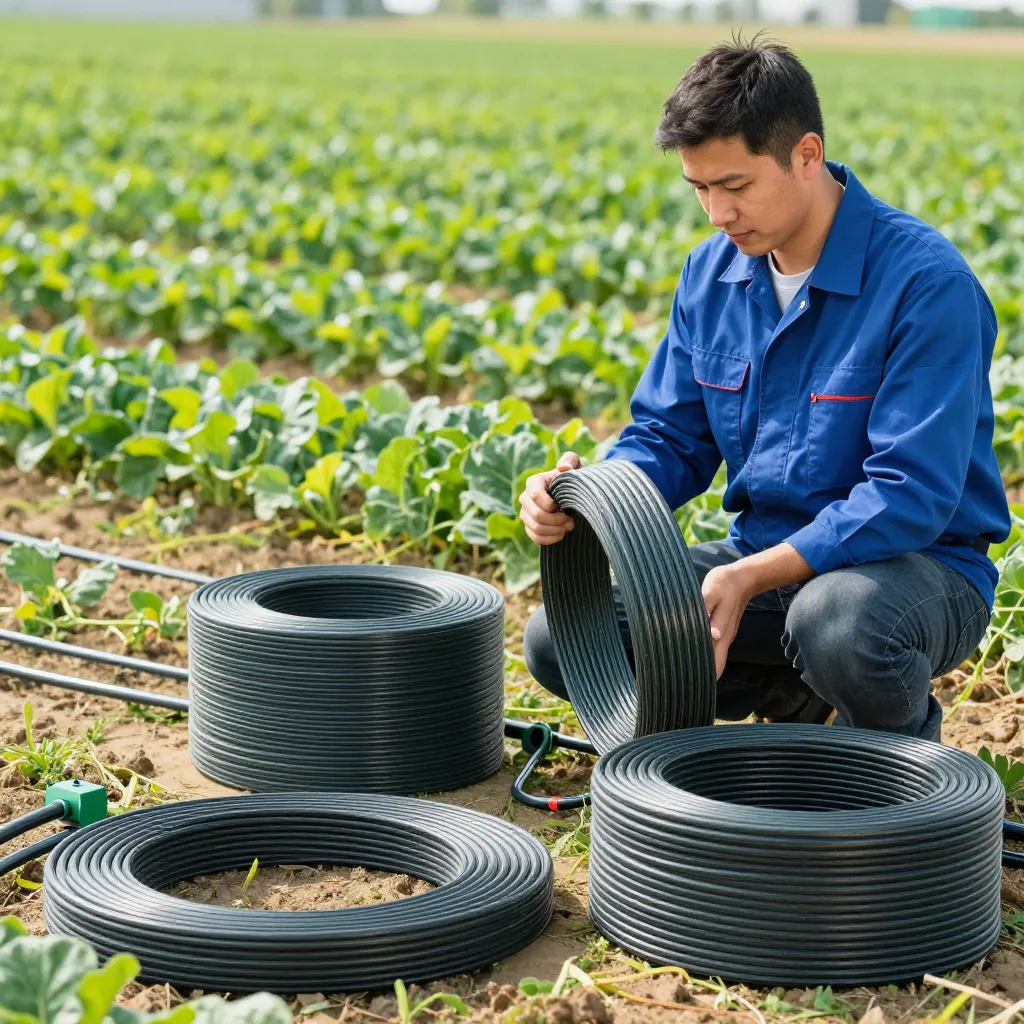
Modern agricultural drip tape represents a pinnacle of precision polymer extrusion. Unlike thick-walled rigid dripline tubing, drip tape is manufactured as thin-walled polyethylene pipe (typically 0.15 mm to 0.63 mm / 6 to 25 mil wall thickness) designed for one-season to multi-year deployment:
- Seamless Continuous Extruded Tape: Manufactured with an integrated turbulent flow channel extruded directly into the inner pipe wall during fabrication (IrriNex DRT-FLT flat drip tape). Features continuous filtration slits along the entire inner seam, providing exceptional resistance to sand bridging and mechanical separation during high-speed mechanical reel deployment.
- Welded Discrete Flat Emitter Tape: Features injection-molded flat labyrinth emitters welded to the inner wall at predetermined intervals (10 cm to 50 cm). These compact molded labyrinths offer precise flow path tolerances, producing a low manufacturer's coefficient of variation (\(CV \le 0.03\)).
Wall Thickness Selection: Mils, Mechanical Durability, and Longevity
Wall thickness is specified globally in thousandths of an inch (mils, where 1 mil = 0.0254 mm = 25.4 microns). Sizing wall thickness dictates tensile strength, puncture resistance, operating pressure ceiling, and economic life:
| Wall Thickness |
Metric Equivalent |
Maximum Working Pressure |
Target Soil / Crop Conditions |
Typical Lifespan & Deployment |
| 6 mil (0.15 mm) |
150 μm |
0.70 bar (10.0 psi) |
Ultra-fine rock-free sandy loam; flat ground |
Single season annuals (strawberries, melons); discarded post-harvest |
| 8 mil (0.20 mm) |
200 μm |
0.80 bar (11.5 psi) |
Standard row crop soils; minor stone content |
Single season standard (processing tomatoes, sweet corn, peppers) |
| 10 mil (0.25 mm) |
250 μm |
1.00 bar (14.5 psi) |
Heavier clay soils, surface rocks, light insect pressure |
1 to 2 seasons; higher retrieval tensile strength |
| 12 mil (0.30 mm) |
300 μm |
1.20 bar (17.5 psi) |
Shallow subsurface burial (5–10 cm); stony soils |
2 to 3 seasons; multi-crop rotations with mechanical retrieval |
| 15 mil (0.38 mm) |
380 μm |
1.50 bar (22.0 psi) |
Subsurface Drip Irrigation (SDI, 15–25 cm burial) |
3 to 5 years permanent or semi-permanent row crops (alfalfa, cotton) |
| 25 mil (0.63 mm) |
630 μm |
2.00 bar (29.0 psi) |
Heavy-duty multi-year berry crops, nurseries |
5+ years; extreme puncture and insect resistance |
Emitter Spacing Dynamics and Soil Capillary Wetting Bulbs
Emitter spacing along the drip tape must match the lateral capillary spread of the soil type to establish a continuous, uniform wetted moisture band along the seedbed:
- Coarse Sandy Soils (Low Capillary Spread): Water moves primarily downward due to gravitational forces with minimal lateral movement (lateral wetted radius < 15 cm). Use tight emitter spacing of **10 cm to 20 cm (4 to 8 inches)** with lower emitter discharge rates (0.5 to 0.8 L/h). Wide spacing in sand leaves dry bridges between plants, causing root desiccation.
- Medium Loam Soils (Balanced Capillary Spread): Capillary forces create well-formed spherical wetting bulbs with lateral spread of 25 to 35 cm. Standard spacing of **30 cm (12 inches)** provides seamless overlap for most row crops.
- Heavy Clay Soils (High Capillary Spread): Strong matric suction pulls water laterally 40 to 60 cm from the emitter, while vertical infiltration is slow. Use wide emitter spacing of **40 cm to 50 cm (16 to 20 inches)** with ultra-low flow emitters to prevent surface ponding and root-zone hypoxia.
Nominal Flow Rates: Low-Flow vs. Standard-Flow Emitters
Drip tape emitter discharge is rated at 0.70 bar (10.0 psi) and categorized into three operational classes:
- Low-Flow Emitters (0.5 to 0.8 L/h / 0.13 to 0.21 GPH): Enables ultra-long lateral runs (up to 250–350 meters) without exceeding the 10% pressure drop rule. Ideal for large commercial fields where long row lengths reduce mainline piping and submain valve manifold investment.
- Standard-Flow Emitters (1.0 to 1.4 L/h / 0.26 to 0.37 GPH): The standard choice for commercial vegetables (tomatoes, onions, broccoli) on 100 to 180 meter beds. Delivers adequate water volume within standard 2 to 3 hour daily runtime windows.
- High-Flow Emitters (1.5 to 2.2 L/h / 0.40 to 0.58 GPH): Reserved for highly permeable coarse gravel soils or rapid pre-wetting of germination beds where large volumes must be delivered before deep gravitational loss occurs. Severely limits maximum lateral run length to under 100 meters.
Maximum Lateral Run Length and the 10% Pressure Drop Rule
In micro-irrigation hydraulic design, the pressure variation across an entire drip lateral should not exceed 10% of nominal operating pressure, which restricts flow variation to under 5% (\(q_{\text{var}} \approx 0.5 \cdot P_{\text{var}}\)):
$$ \Delta P_{\text{lateral}} = P_{\text{inlet}} - P_{\text{tail}} \le 0.10 \cdot P_{\text{nominal}} $$
Friction loss along the lateral is calculated using the Darcy-Weisbach or Hazen-Williams equation modified by the Christiansen F-factor for multi-outlet pipelines. When row lengths exceed allowable hydraulic limits for 16mm (5/8") tape, engineers must either size up to 22mm (7/8") drip tape, deploy lower-flow emitters, or feed the lateral from a center submain manifold to divide row lengths in half.
Emitter Discharge Hydraulics and Flow Exponent (\(x\))
The flow rate of an individual drip tape emitter is governed by the power law equation:
$$q = k \cdot P^x$$
Where \(q\) is discharge, \(k\) is emitter discharge coefficient, \(P\) is water pressure, and \(x\) is the emitter discharge exponent. For non-pressure-compensating turbulent labyrinth drip tape, \(x\) typically ranges between 0.48 and 0.52 (nominal \(x = 0.50\)):
- Hydraulic Consequence of \(x = 0.50\): Emitter discharge varies directly with the square root of pressure. If lateral pressure drops by 20% due to friction, emitter discharge drops by approximately 10%. This sensitivity makes strict lateral sizing and upstream pressure regulation mandatory.
- Coefficient of Manufacturing Variation (\(CV\)): ISO 9261 requires that high-quality drip tape achieve a manufacturing variation \(CV \le 0.05\) (Class A). IrriNex DRT-FLT precision extruded tape achieves \(CV < 0.03\), ensuring that emitter-to-emitter manufacturing tolerances do not compromise crop uniformity.
Step-by-Step Worked Hydraulic Sizing: Processing Tomato Bed
The following engineering calculation sizes a drip tape lateral for a commercial processing tomato block on 1.8-meter (6-foot) bed centers:
- Row Length: 220 meters (721 feet).
- Nominal Tape Diameter: 16 mm (Inside Diameter \(d = 16.1\text{ mm}\)).
- Emitter Spacing (\(S_e\)): 0.30 meters (12 inches) → \(N = 733\) emitters per lateral.
- Nominal Emitter Flow (\(q_e\)): 1.0 L/h at 0.70 bar (0.26 GPH at 10.1 psi).
- Target Inlet Pressure: 0.80 bar (11.6 psi).
Step 1: Calculate Total Lateral Inflow Rate
$$Q_{\text{lat}} = N \times q_e = 733 \times 1.0\text{ L/h} = 733\text{ L/h} = 0.2036\text{ L/s} \quad (3.23\text{ GPM})$$
Step 2: Calculate Continuous Pipe Friction Head Loss (Hazen-Williams)
Using \(C = 150\) for smooth extruded polyethylene:
$$J = 1.22 \times 10^{10} \times \left( \frac{0.2036}{150} \right)^{1.852} \times (16.1)^{-4.87} = 0.0212\text{ m/m}$$
$$H_{f,\text{plain}} = J \times L = 0.0212 \times 220\text{ m} = 4.66\text{ meters of head}$$
Step 3: Apply Christiansen Multi-Outlet Reduction Factor (\(F\))
For \(N > 100\), \(F \approx \frac{1}{2.852} + \frac{1}{2N} \approx 0.351\):
$$H_{f,\text{actual}} = F \times H_{f,\text{plain}} = 0.351 \times 4.66\text{ m} = 1.636\text{ m} \quad (0.160\text{ bar} = 2.32\text{ psi})$$
Step 4: Check Pressure Variation Rule
$$\Delta P_{\text{lateral}} = 0.160\text{ bar} \le 0.10 \times 0.80\text{ bar} = 0.08\text{ bar} \quad \text{-- EXCEEDS ALLOWABLE LIMIT!}$$
Engineering Diagnosis & Remedy: At 220 meters, 16mm tape with 1.0 L/h emitters incurs a 0.16 bar drop (20% pressure variation), causing 10% flow starvation at the row tail. To restore 90%+ uniformity, the engineer has two options: (a) Upsize to 22mm drip tape (which reduces friction loss by 65%), or (b) Switch to 0.6 L/h low-flow emitters on the 16mm tape.
Multi-Crop Drip Tape Selection Matrix
| Crop |
Target Soil Textures |
Recommended Wall Thickness |
Emitter Spacing |
Emitter Flow Rate |
Placement Depth |
| Strawberries |
Sandy loam / Light loam |
8 mil (0.20 mm) |
20 cm (8 in) |
0.8 to 1.0 L/h |
Surface under plastic mulch |
| Processing Tomatoes |
Loam / Clay loam |
10–12 mil (0.25–0.30 mm) |
30 cm (12 in) |
1.0 L/h |
Subsurface (5–10 cm) |
| Melons & Watermelons |
Sandy soil |
8–10 mil (0.20–0.25 mm) |
30 cm (12 in) |
1.0 to 1.2 L/h |
Surface under mulch |
| Cotton / Maize |
All soil classes |
12–15 mil (0.30–0.38 mm) |
30–40 cm (12–16 in) |
0.6 to 0.8 L/h |
Subsurface SDI (20–30 cm) |
| Onions & Carrots |
Silt loam / Sandy loam |
8–10 mil (0.20–0.25 mm) |
10–15 cm (4–6 in) |
0.5 to 0.7 L/h |
Surface closely spaced twin-lines |
Field Deployment, Tension Controls, and Retrieval
Improper mechanical installation damages thin-walled drip tape before irrigation even commences. Adhere to four field deployment protocols:
- Emitter Orientation Facing Upward: Always mount drip tape reels so that emitter exit slits point strictly upward toward the sky. Upward orientation prevents heavy mineral silt from settling into the emitter labyrinth when flow ceases.
- Tension Calibration on Injection Rigs: Tractor injection shanks must guide the tape through smooth, polished ceramic or roller guides. Excessive reel braking tension stretches thin polyethylene tape; a 5% mechanical stretch alters emitter spacing and narrows internal diameter, creating severe unexpected friction loss.
- Upstream Pressure Regulation: Drip tape is thin-walled and will burst if subjected to mainline pumping pressure. Always install an IrriNex IRX-SPR pressure reducing valve upstream set to 0.7 to 1.0 bar, paired with a downstream safety pressure relief valve.
- End-of-Season Flushing: Install manual flush valves (IrriNex VAL-BV-LG) or fold-over ends at lateral tails. Flush laterals at 0.5 m/s flushing velocity at initial startup and monthly thereafter to discharge accumulated silt particles.
Frequently Asked Questions on How To Choose Drip Tape For Commercial Crops
What are the common commercial drip tape wall thicknesses and their recommended uses?
6 mil (0.15mm): Single-season shallow surface crops on smooth soils (strawberries, melons); 8 mil (0.20mm): Standard commercial seasonal vegetable crops (tomatoes, peppers, corn); 10–12 mil (0.25–0.30mm): Multi-season or stony soils; 15 mil (0.38mm): Heavy-duty semi-permanent subsurface drip.
What is the maximum operating pressure for standard thin-wall drip tape?
Thin-wall drip tape (6–8 mil / 0.15–0.20mm) has a nominal operating range of 0.4 to 1.0 bar (6 to 15 PSI), with maximum limit of 1.2 to 1.5 bar (17 to 22 PSI). Burst pressure is approximately 2.0 to 2.5 bar; pressure regulators are mandatory.
How do you match drip tape emitter spacing (10cm, 20cm, 30cm) to soil type?
Coarse sandy soils have minimal lateral capillary spread; use close spacing (10 to 20 cm) to merge wetting bulbs. Loam and clay soils have wide lateral capillary spread; 30 to 50 cm spacing creates a continuous uniform wetted strip.
When should a grower choose 22mm (7/8") diameter drip tape over standard 16mm (5/8")?
Choose 22mm diameter tape when row lengths exceed 250 to 400 meters. The larger cross-sectional area cuts friction head loss by over 60%, maintaining 90%+ emission uniformity on long commercial rows.