Battery Irrigation Controllers: Estimate Service Life from the Duty Cycle
Estimate a battery irrigation controller's service interval from its complete battery-side duty cycle, then verify that it can still execute the required valve commands near the planned replacement point. Standby electronics, opening and closing events, communications and retries all consume charge. An ampere-hour calculation alone cannot establish that the battery maintains sufficient voltage during a command.
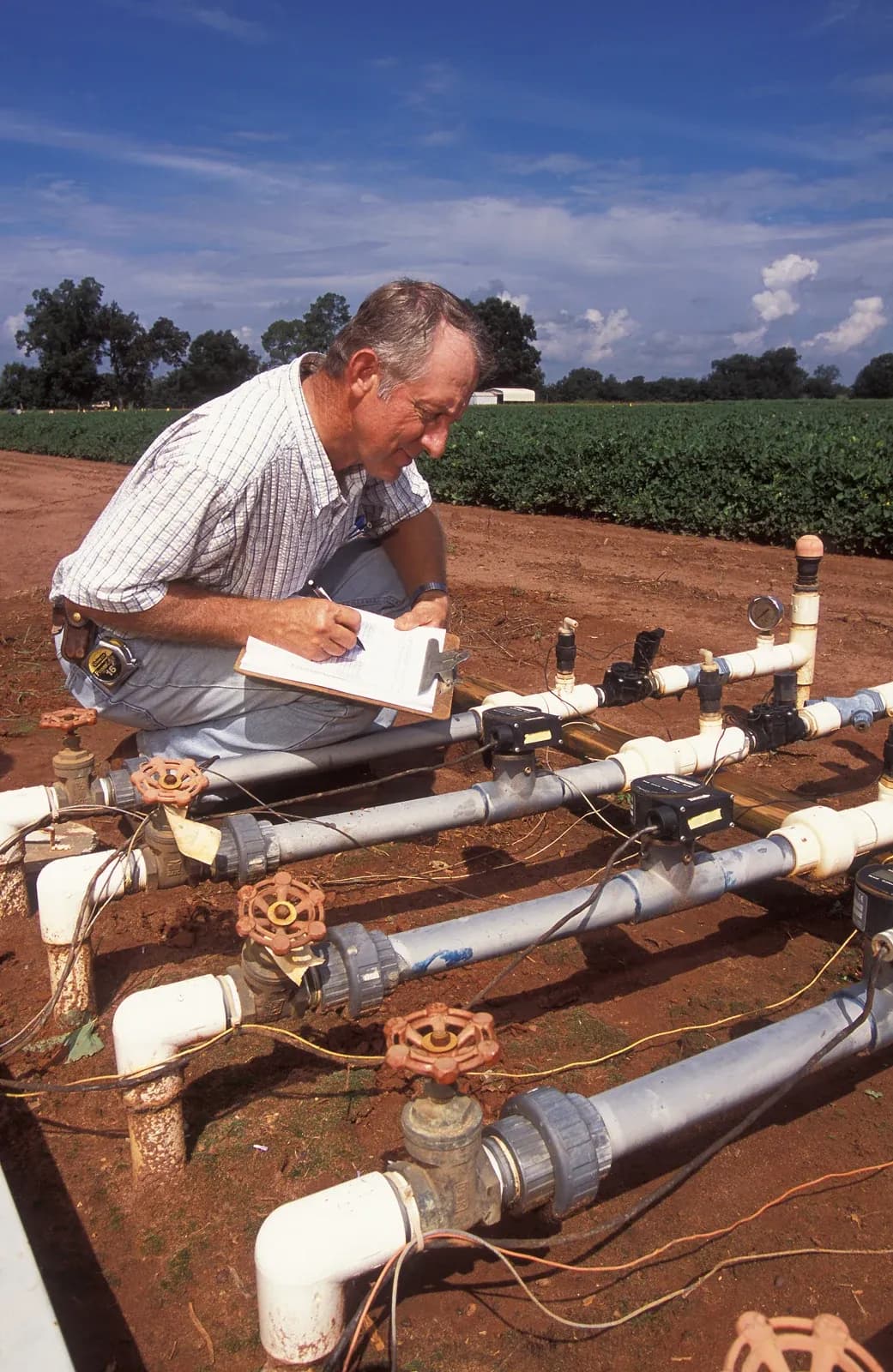
Field observations beside irrigation pipelines, handwheel valves and wired waterflow instruments. This photograph is not a battery controller service-life test. Photo: Peggy Greb, USDA Agricultural Research Service.
This guide builds a maintenance budget for a battery controller serving agricultural irrigation valves. All currents, event durations, capacities and reserve choices in the worked example are hypothetical. They are not measured IrriNex performance, battery specifications or a universal replacement schedule.
1. Define the battery and controller configuration being assessed
Record the controller model, firmware, approved battery type, battery arrangement, solenoid compatibility and communication settings. Confirm whether the batteries operate the field valves or merely preserve the clock and settings. A backup battery in an AC controller is a different duty from the operating battery in a remote valve controller.
Use the capacity of the approved battery arrangement at the applicable operating conditions. Do not add cell capacities simply because the compartment holds several cells. Series connections add voltage, while the usable charge of the assembled string is constrained by its cells and operating limits. Use the supplied configuration rather than constructing a different pack to extend life.
Identify the applicable low-battery warning, controller cutoff and required valve-command performance. Distinguish nominal capacity on a cell label from usable charge delivered before the controller can no longer meet its requirements. Temperature, storage history, discharge pattern and the required minimum voltage belong in that assessment; an unverified percentage adjustment cannot represent every chemistry.
The controller and solenoid compatibility guide provides the architectural starting point. A latching arrangement can avoid continuous coil holding current, but the controller's electronics and other functions can continue drawing power while irrigation is running.
2. Count battery-consuming events over the actual schedule
Count opening and closing commands separately. If one valve receives 18 complete irrigation cycles per day and each cycle uses one opening and one closing event, the schedule contains 36 valve-command events. Include additional pulses, retries, manual tests and recovery actions if the actual controller performs them.
List communications by what the device does, not only by how often a successful reading appears on the dashboard. Radio wake-up, connection attempts, receive windows, retransmissions and configuration sessions may contribute to the battery duty. Sensor excitation, display illumination and local button use can add other event classes.
Measure or obtain consumption at the battery terminals for the complete event. A solenoid pulse observed at the output is not automatically the battery-current waveform. Voltage conversion, stored energy and subsequent recharging inside the controller can change when charge leaves the battery. Include the entire event window needed to capture those effects.
Use a documented baseline-plus-events model or a set of mutually exclusive operating states. In the first method, event charge must be the additional charge above the already-counted baseline. In the second, each state's current is multiplied by the time spent in that state. Mixing full event currents with a full-day baseline can count the same consumption twice.
3. Convert standby current and events into a daily charge budget
Rice University's OpenStax definition of electrical current relates current to charge flowing per unit time. For a constant-current interval, charge in mAh equals current in mA multiplied by duration in hours. With duration in seconds, divide the product by 3,600. For a varying current, integrate the measured current over the event.
Assume the example controller has a continuous baseline battery current of 0.15 mA. Each valve-command event adds the equivalent charge of 200 mA for 0.12 s above that baseline. Each communication session adds the equivalent charge of 30 mA for 6 s above baseline. These equivalent rectangular events simplify arithmetic; they are not a claimed coil waveform or programming instruction.
| Contribution | Assumed daily duty | Calculation | Charge per day |
|---|---|---|---|
| Continuous baseline | 0.15 mA for 24 h | 0.15 × 24 | 3.60 mAh |
| Valve commands above baseline | 36 events, 200 mA for 0.12 s equivalent each | 36 × 200 × 0.12 ÷ 3,600 | 0.24 mAh |
| Communications above baseline | 24 sessions, 30 mA for 6 s equivalent each | 24 × 30 × 6 ÷ 3,600 | 1.20 mAh |
The total is 3.60 + 0.24 + 1.20 = 5.04 mAh/day. The example assumes these contributions cover the device's electrical consumption for the stated duty. Battery self-discharge and calendar effects still need consideration in the usable-capacity assessment; the current table does not measure them.
The baseline is larger than the command contribution in this example. Reducing irrigation run time while keeping the same number of open and close events would not reduce the assumed command charge. That result applies to this model: a different controller may consume power differently while a valve is open.
Keep charge and energy units distinct. mAh describes charge, while Wh describes energy and depends on voltage over the discharge. Do not compare two different battery voltages using mAh alone. If consumption and available energy are stated at different electrical boundaries, account for conversion behavior before using them in one calculation.
4. Recalculate for retries and a lower available-capacity case
Assume suitable application data establish 1,000 mAh of available battery charge before the required operating endpoint under the first example conditions. Choose an additional 30% maintenance reserve for this teaching exercise. The planned consumption budget is therefore 1,000 × 0.70 = 700 mAh. Neither the capacity nor the reserve is a universal battery rule.
At the normal 5.04 mAh/day duty, the simple quotient is 700 ÷ 5.04 = 138.9 days, rounded. Treat that result as the modeled time to consume the chosen budget, not a guaranteed date of battery failure or an automatic replacement interval. Field conditions and the command-voltage check still govern the service plan.
Now assume the same valve schedule but 96 communication sessions per day, including repeated attempts, with the same incremental charge per session. Communications consume 96 × 30 × 6 ÷ 3,600 = 4.80 mAh/day. Total consumption becomes 8.64 mAh/day, and the 700 mAh budget lasts only about 81.0 modeled days.
| Scenario | Available charge before reserve | Budget after 30% reserve | Daily consumption | Modeled budget duration |
|---|---|---|---|---|
| 24 communication sessions per day | 1,000 mAh | 700 mAh | 5.04 mAh/day | 138.9 days |
| 96 communication sessions per day | 1,000 mAh | 700 mAh | 8.64 mAh/day | 81.0 days |
| 96 sessions with an independently assessed lower-capacity condition | 500 mAh | 350 mAh | 8.64 mAh/day | 40.5 days |
The final row is a separate hypothetical condition with half the available charge. It is not a claim that cold weather halves every battery's capacity. The actual capacity must come from the approved battery's relevant data or testing, and a changed condition may also change current consumption. Holding the duty constant here isolates the arithmetic effect of capacity.
A proposed 90-day visit interval consumes 453.6 mAh in the first scenario but 777.6 mAh in the retry scenario. The latter exceeds its 700 mAh budget. A 60-day interval consumes 518.4 mAh at the retry duty, which fits 700 mAh but exceeds the final row's 350 mAh budget. A convenient calendar interval cannot replace the limiting-case assessment.
The unreliable-connectivity irrigation guide helps separate local control from network availability. Review the device's documented retry behavior rather than assuming that a lost connection stops radio consumption. Changing reporting frequency must also preserve the information and response times the farm requires.
5. Check command voltage as well as remaining charge
A battery can retain charge yet fail to maintain the voltage needed during a demanding event. OpenStax's treatment of battery internal resistance explains why terminal voltage under discharge can fall as load current increases. Its simple electrical model is useful background; it is not a complete prediction of a particular battery's short-pulse behavior.
Obtain the controller's approved battery-check method and evaluate voltage under the required operating event, especially near the planned service endpoint. A resting voltage reading alone does not demonstrate that the closing command will succeed. Include the relevant temperature, battery age and permitted solenoid configuration when reviewing that evidence.
Do not infer that a latching valve closes automatically when the batteries are exhausted or removed. Identify the documented low-battery behavior and how the installation confirms the required water state. A remaining-charge reserve is not evidence of a working emergency-closing function. Keep the local isolation and operating procedure available to the responsible person.
Use suitable instrumentation and the manufacturer's procedure when measuring current. An incorrectly connected meter or an intrusive measurement setup can alter the event being assessed. The practical aim is an applicable consumption record, not an improvised battery or controller modification.
6. Select a service interval with evidence for each decision
| Decision | Evidence to retain | Unresolved result |
|---|---|---|
| Daily consumption represents the field duty | Baseline, command counts, complete event charge and retry records | Keep the estimate provisional |
| Available capacity applies to the installation | Approved battery data or suitable testing with operating endpoint and conditions | Do not substitute nominal label capacity |
| Required valve commands remain achievable | Approved loaded-voltage and functional checks near the planned endpoint | Review the service interval and operating arrangement |
| The visit interval preserves the chosen reserve | Limiting-case budget, access arrangements and responsible operator | Shorten or otherwise revise the supported plan |
Include travel and access constraints in the maintenance plan. Seasonal field operations, flooding or a locked enclosure may prevent a planned visit. A warning that occurs after the last practical service opportunity is not sufficient simply because it appears on a dashboard.
The irrigation alarm-design guide provides the response-planning context. Record who receives a low-battery indication, how they confirm it and how the controller's actual water-control state is checked. Set the action from the device and farm requirements, not a generic voltage threshold copied from another battery chemistry.
7. Maintain a battery record that can improve the estimate
Record battery installation date, approved type, controller identity, firmware and relevant configuration. At service, retain the duty counters, communication-attempt history, temperature observations, battery indication and the approved functional check. Note changes to valve count, pulse behavior, attached sensors or reporting intervals.
Compare predicted consumption with the available field evidence over repeated service periods. Investigate a short interval before simply installing another battery: communication retries, a changed load, unsuitable cells, poor contacts or environmental conditions require different responses. A controller's displayed percentage may be an estimate rather than a direct measurement of remaining mAh.
The irrigation connectivity comparison helps document the communication arrangement. If the network or reporting configuration changes, update the charge budget and service review. Retain the earlier assumptions so the reason for the new interval is clear.
8. Questions about battery irrigation controller service life
Will fewer watering minutes always extend battery life?
No. With a latching arrangement, the number of state-change events can matter more than how long the valve remains open. Standby and communication consumption may continue throughout the day. Use the actual controller's duty model.
Can the battery capacity divided by average current give an exact replacement date?
It gives a simplified charge-budget duration when the inputs apply. Usable capacity, operating voltage, temperature, storage effects and changing duty can limit service earlier. Verify the required valve commands and preserve the chosen maintenance reserve.
Should batteries be changed once a year in every controller?
Follow the exact equipment's instructions and the supported site service plan. An annual interval may be suitable for some duties, but it is not established by the words battery-powered. Record the assumptions, limiting conditions and evidence for the chosen interval.